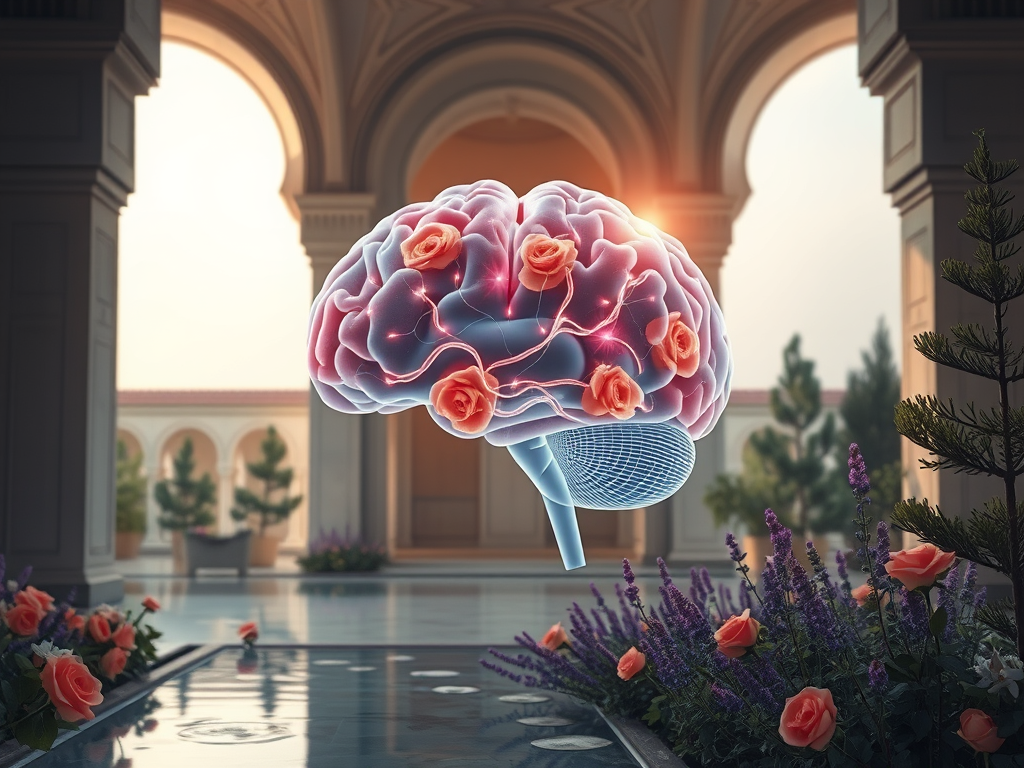
We often think of architecture as visual—lines, light, form, and space. But what about smell? A faint trace of lavender, damp concrete, old wood, or hospital disinfectant. Scents we barely notice, yet they linger—anchored deep in memory and emotion.
Have you ever stepped into a space and instantly felt calm, alert—or uneasy—without knowing why?
That reaction may not come from what you see, but from what you breathe.
Smell and Cognitive Health
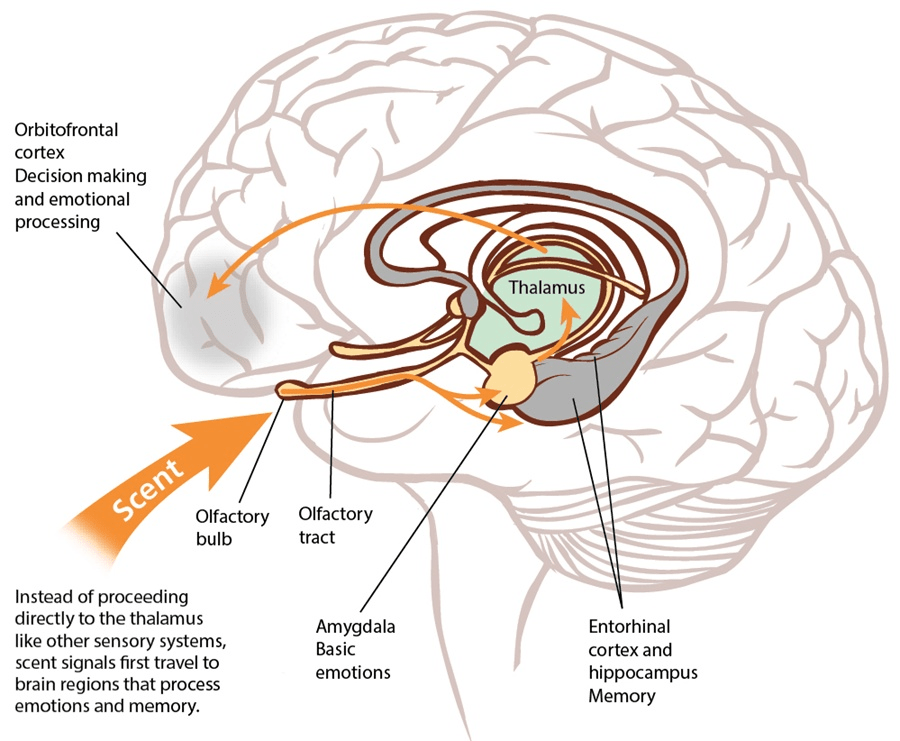
Recent research indicates that smell can do more than trigger memories—it can actively support brain health.
In a 2023 study, healthy older adults exposed to various natural scents during sleep (using an odour diffuser) showed significant improvements in memory and language skills. This process, known as olfactory enrichment, is now being explored as a way to prevent cognitive decline.
Researchers are even investigating its benefits for people with Alzheimer’s or Parkinson’s, where sensory decline and memory loss are common. Because the olfactory system is directly connected to the brain’s emotional and memory centres, scent-based stimulation may help preserve function where other therapies fall short.
Designing with smell, then, is more than aesthetic—it may be a way to support cognitive resilience.

A serene Islamic garden featuring lush greenery, fountains, and intricate architecture, designed to engage the senses and evoke emotions.
Case Studies:
Scent in Islamic Garden Design
One of the most enduring examples of olfactory design can be found in Islamic gardens. Often described as “paradise gardens”, these spaces were not only visual compositions—they were multisensory environments, carefully crafted to engage smell, sound, and emotion.
Plants such as jasmine, myrtle, basil, and roses were selected not only for their beauty, but for their fragrance. Their scents drifted through shaded courtyards and narrow pathways, carried by gentle breezes and the sound of flowing water. Fountains and channels layered the sensory experience, creating harmony that was both spiritual and physical.
In these gardens, smell was a deliberate design element—used to calm the mind, connect with the divine, and experience beauty beyond the visual.
This ancient wisdom reminds us of how deeply rooted our connection to scent truly is—and how often modern architecture overlooks it.
Revisiting this approach can inspire today’s designers to create environments that soothe, stimulate, and restore—not just through form, but through fragrance.

Scent and Sacred Architecture
Religious spaces have long used scent to shape emotion and experience. In Christian churches, particularly in Catholic, Orthodox, and some Anglican traditions, incense—made from resins like frankincense and myrrh—is burned during rituals.
Its rising smoke symbolises prayer, but its olfactory impact is equally powerful. The scent signals reverence, stillness, and memory. It transforms the atmosphere into something sacred, setting the tone for reflection or awe.
A 2008 study from Johns Hopkins University and the Hebrew University found that burning frankincense activates ion channels in the brain associated with warmth perception and emotional regulation, particularly the TRPV3 channel.
“This suggests that incense has psychoactive properties that affect the brain in ways that could explain its long use in spiritual rituals.”
This is another example of how architecture, ritual, and smell have worked together—long before neuroscience explained why such environments move us so deeply.
Final Thoughts
Designing with smell means more than eliminating bad odours.
It’s about choosing breathable materials, integrating natural ventilation, using indoor plants, and considering the emotional effect of building finishes and ambient scents.
Even something as simple as planting rosemary near a window, using untreated wood, or placing a scent diffuser in a meditation room can help reintroduce scent into the language of design—gently, intentionally.
Because scent isn’t just a decoration.
It’s information.
It’s connection.
It’s memory.
As Helen Keller once wrote:
“Smell is a potent wizard that transports you across thousands of miles and all the years you have lived.”
So… what does your space smell like?
References
Overnight olfactory enrichment using an odorant diffuser improves memory and modifies the uncinate fasciculus in older adults. https://www.frontiersin.org/journals/neuroscience/articles/10.3389/fnins.2023.1200448/full
What the nose knows. Experts discuss the science of smell and how scent, emotion, and memory are intertwined — and exploited. https://news.harvard.edu/gazette/story/2020/02/how-scent-emotion-and-memory-are-intertwined-and-exploited/#:~:text=Smells%20are%20handled%20by%20the,related%20to%20emotion%20and%20memory.
Why Smells and Memories Are So Strongly Linked in Our Brains https://www.psychologytoday.com/us/blog/the-athletes-way/202103/why-smells-and-memories-are-so-strongly-linked-in-our-brains
Incense is psychoactive: Scientists identify the biology behind the ceremony https://phys.org/news/2008-05-incense-psychoactive-scientists-biology-ceremony.html
The Connections Between Smell, Memory, and Health https://magazine.hms.harvard.edu/articles/connections-between-smell-memory-and-health
Familiar scents could spark happy memories for patients with depression, a study says https://nypost.com/2024/03/05/health/familiar-scents-could-spark-happy-memories-for-patients-with-depression-study-says/?utm_source=chatgpt.com
 neurotectura.com
One thought on “The Forgotten Sense: Smell in Neuroarchitecture”