
We know that children’s attention is brief by nature. In the case of children with ADHD or other neurodivergent conditions, that window may be even shorter, more fragmented, and more sensitive to the environment.
However, most school spaces are still designed as if all students have the same ability to focus, filter stimuli, and orient themselves intuitively.
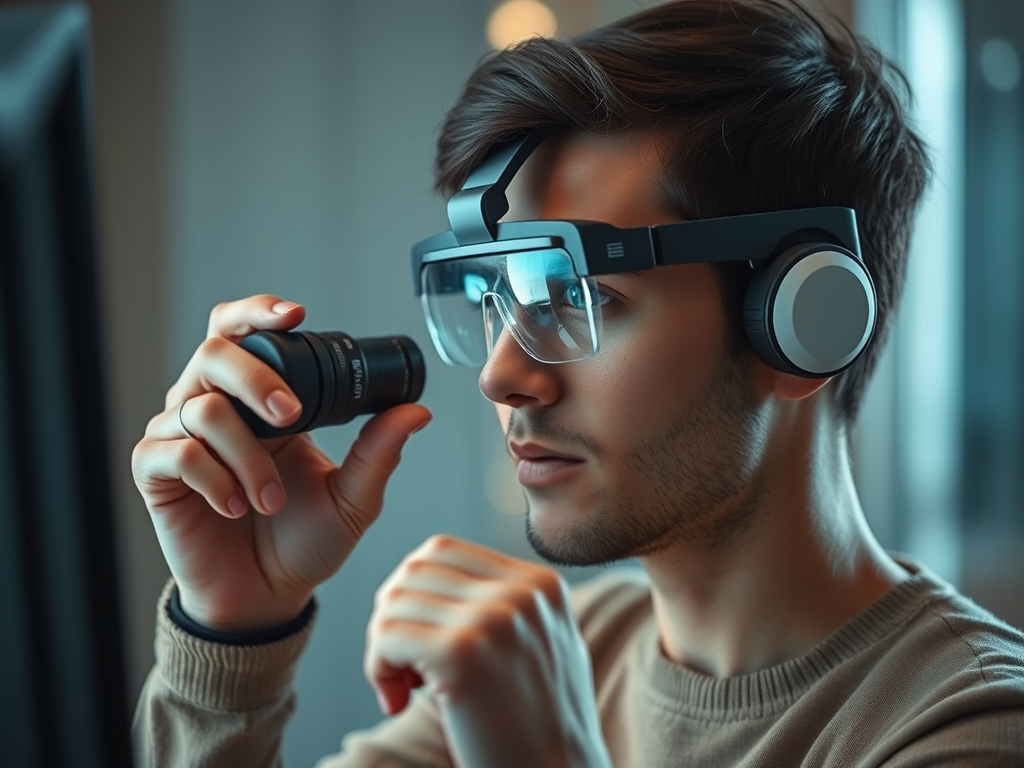
What would happen if, instead of relying on assumptions, we designed schools based on what children actually observe?
A recent study, conducted with 57 school-aged children, explored this possibility. Using portable eye-tracking technology (glasses with visual sensors), researchers observed the visual attention patterns of students as they navigated real—not simulated—spaces on their daily commute to school.
The results were revealing:
- 🔸 Most children ignored the institutional signage located at adult height.
- 🔸 Her attention naturally focused on lively and contrasting elements, such as plants, people, vibrant colours, or ground-level references.
- 🔸 Many stimuli designed to guide them simply went unnoticed.
These findings allowed for the redesign of signage and landmarks based on the authentic visual behaviour of children—reducing confusion, increasing autonomy, and creating more intuitive environments for everyone.
What is eye tracking?
Eye tracking is a sophisticated technology that captures and analyses where and how we look at objects or visual scenes. Essentially, it involves measuring the point of gaze (where we are looking) or the movement of an eye in relation to the head.
This technology leverages advanced sensors and algorithms to accurately track a user’s eye movements, which provides insights into visual attention, cognitive processing, and behavioural intentions.
Researchers have used eye tracking and electroencephalograms to analyse how factors of the built environment, such as ceiling height, room size, and luminosity, impact cognitive and attentional responses. These studies can guide more effective architectural designs.
All of this, along with virtual reality, allows for rapid testing of responses to different designs, facilitating data-driven decisions rather than subjective opinions, thus improving architectural outcomes.
The integration of eye-tracking with technologies such as virtual reality (VR) and augmented reality (AR) opens new possibilities for neuroarchitecture, allowing designers to explore and validate spatial experiences before they are built.
Eye Tracking Applications in Neuroarchitecture
Whether for advancing scientific research or improving consumer products and services, eye tracking technology resides at the intersection of human cognition and digital innovation, providing deep insights into the silent language of our eyes.
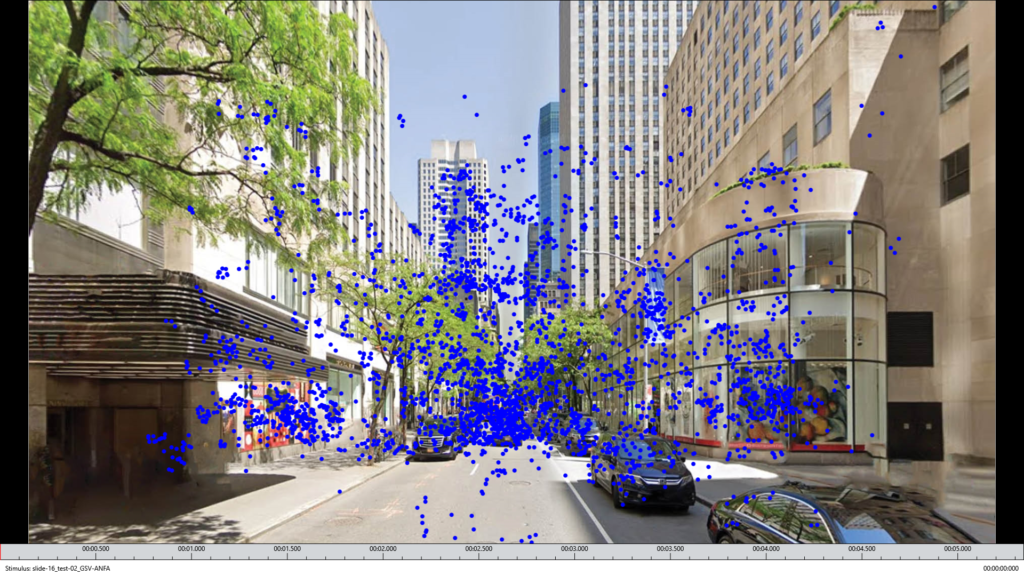
The artwork at Christie’s captures attention on the lower floors of the building to the right.
User-centred Design
Eye tracking can help designers observe how users visually interact with a space in real time. This allows for a better understanding of which elements capture attention or which aspects of the design may not be working as expected.
In museums or retail environments, it reveals which exhibits or products are consistently overlooked, pointing to the need for spatial or visual redesign.
In offices and workspaces, eye-tracking supports more ergonomic, comfortable environments—optimising the use of natural light, calming colours, and visual flow to enhance well-being and productivity.
It also helps map the way users feel guided or disoriented, making it easier to design spaces that invite intuitive movement.
Optimization of Signage and Navigation
Eye-tracking is now commonly used to enhance signage design and spatial orientation in complex buildings like hospitals and airports. It reveals which signs are noticed and which are ignored. This information helps to improve the placement and design of signs, making them more effective and reducing the stress or confusion people often feel in hard-to-navigate areas.
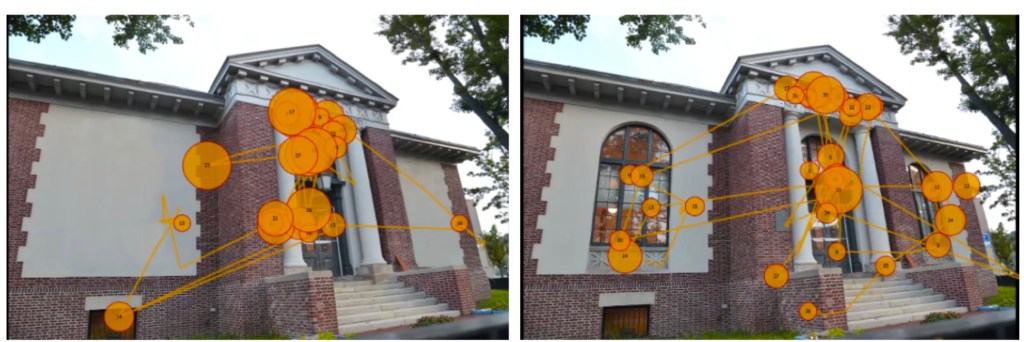
On the left, a digitally edited image with the windows removed; on the right, the original photo of the library’s façade. This comparative study reveals where visual fixations are most concentrated, showing that areas with less contrast or fewer architectural details tend to be overlooked. The findings highlight how subtle design elements—or their absence—can significantly influence what people actually see or ignore in the built environment.
(Study by Ann Sussman and Janice M. Ward)
Impact on Health and Well-being
Eye-tracking can measure how people respond to different visual stimuli: patterns of light and shadow, wall textures, natural elements, or openness.
Studies have indicated that certain spatial features—like outdoor views, vegetation, or soft colour palettes—can reduce stress and elevate mood. In hospitals, spaces designed to promote relaxation can even accelerate healing.
With eye-tracking, we can adjust distracting or overwhelming elements and amplify those that generate calm and comfort, helping design truly therapeutic environments.
“While many architects still follow the principle that form follows function, today’s advertisers and car manufacturers follow a more current idea: form follows brain function. They use advanced technology to decode hidden human behaviours and create products that adapt to them.”
Ann Sussman y Janice M. Ward.
Behaviour and Attention Studies
Architects are increasingly using eye-tracking to conduct behavioural studies—to understand how people engage with public spaces like plazas, parks, and pedestrian zones.
For example, in an urban park, eye-tracking can show which areas attract more attention and why. A green area or water feature might be visually appealing, while darker or less natural corners are ignored or avoided.
This information is vital for designing more welcoming, inclusive and engaging public spaces.

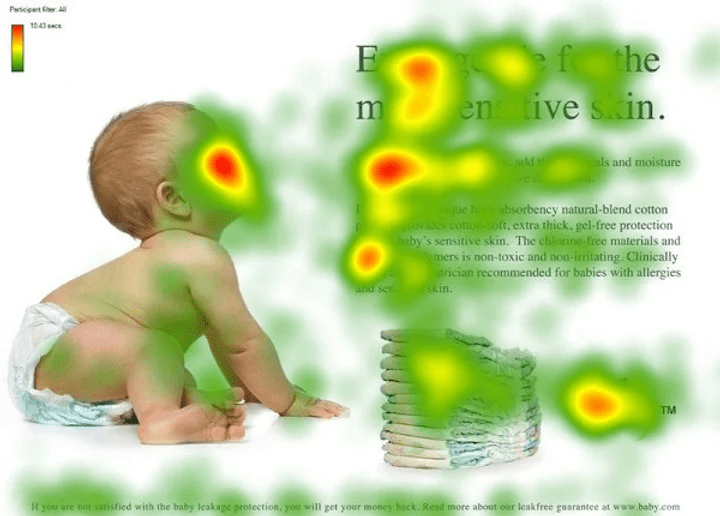
Left: The baby looks at the viewer, drawing attention away from the text.
Right: The baby gazes at the text, and viewers follow that gaze—enhancing focus on the message. Humans instinctively follow where others look, a powerful insight for communication and design.
Eye-tracking is also used in web design, advertising, and retail, revealing which products or areas attract the most attention. This helps adjust layouts, displays, and signage to increase customer engagement and sales—based on real visual behaviour.
Final Reflection
Looking is not the same as seeing.
And designing shouldn’t rely on what we assume people see—but on what truly captures their attention, calms their senses, or invites movement.
Eye tracking is not just a technological tool; it is a way to see from another’s perspective. A path towards a more informed, sensitive, and truly human design.
References
An Eye-Tracking Study on Exploring Children’s Visual Attention to Streetscape Elements https://www.mdpi.com/2075-5309/15/4/605
Eye-Tracking Applications in Architecture and Design https://www.mdpi.com/2673-8392/4/3/86
What can you learn about architecture from tracking people’s eye movements https://www.archdaily.com/884945/heres-what-you-can-learn-about-architecture-from-tracking-peoples-eye-movements
What is Eye-tracking? https://imotions.com/eye-tracking/
5 Ways Neuroarchitecture Shows Us How We React to Buildings. https://imotions.com/blog/insights/research-insights/5-ways-neuroarchitecture-shows-us-how-we-react-to-buildings/
Subjective experience and visual attention to a historic building: A real-world eye-tracking study. https://www.sciencedirect.com/science/article/pii/S2095263520300558
Using Neuro-Architecture to Reinforce Participatory Planning and Design https://theccd.org/article/using-neuro-architecture-to-reinforce-participatory-planning-and-design/
How Neuroscience Can Generate a Healthier Architecture. https://theccd.org/article/how-neuroscience-can-generate-a-healthier-architecture/
How Eye Tracking Technology Is Changing The World [5 Examples] https://imotions.com/blog/insights/trend/future-eye-tracking-technology/
Here’s What You Can Learn About Architecture from Tracking People’s Eye Movement. https://www.archdaily.com/884945/heres-what-you-can-learn-about-architecture-from-tracking-peoples-eye-movements
 neurotectura.com