
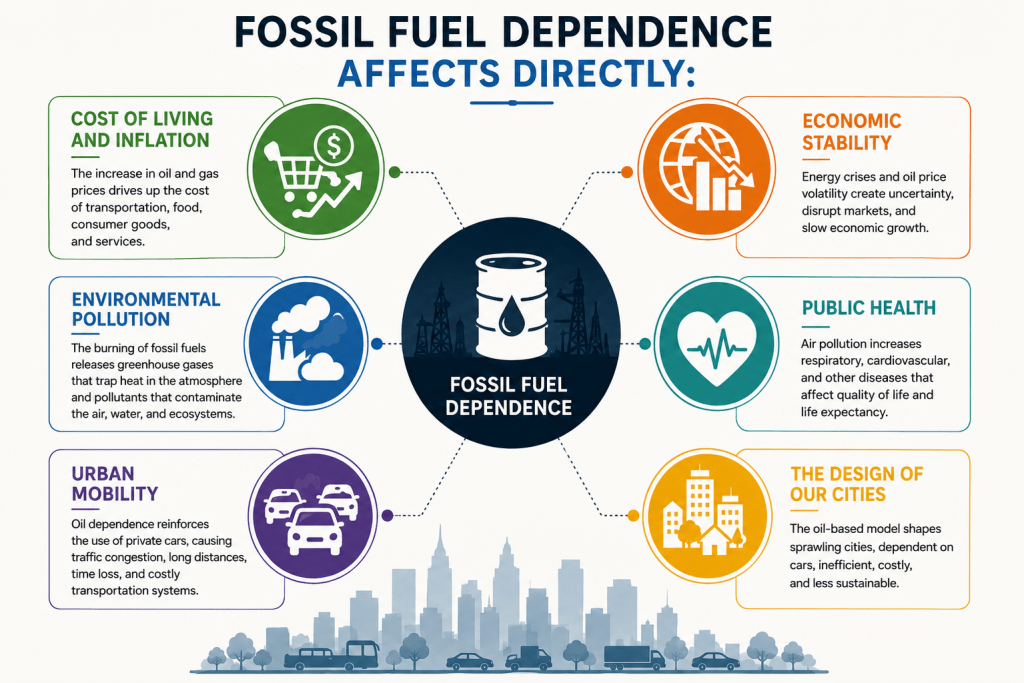
Millions of people begin their day trapped in traffic, glancing anxiously at rising fuel prices. In silence, they calculate whether they can still afford to fill the tank and cover the essentials: getting to work, buying food, or taking their children to school.
This everyday routine reveals a far deeper reality: modern urban life remains profoundly dependent on oil, global supply chains, and geopolitical conflicts unfolding thousands of miles away.
Every energy crisis, market disruption, or surge in petrol prices reminds us that our cities, economies, and lifestyles are still tightly bound to fossil fuels. We rely on them not only for mobility but also for sustaining the most basic functions of contemporary society.
Cities and Energy Consumption
Although cities occupy less than 3% of the Earth’s surface, they concentrate such a high density of population and economic activity that they have become the world’s primary centres of energy demand. Today, urban areas consume between 67% and 80% of global energy, much of it still deeply dependent on oil and natural gas.
For this reason, it is now impossible to separate architecture and urban planning from energy management. The way we design our cities directly determines how much energy we are destined to consume.

Mobility and Urban Models
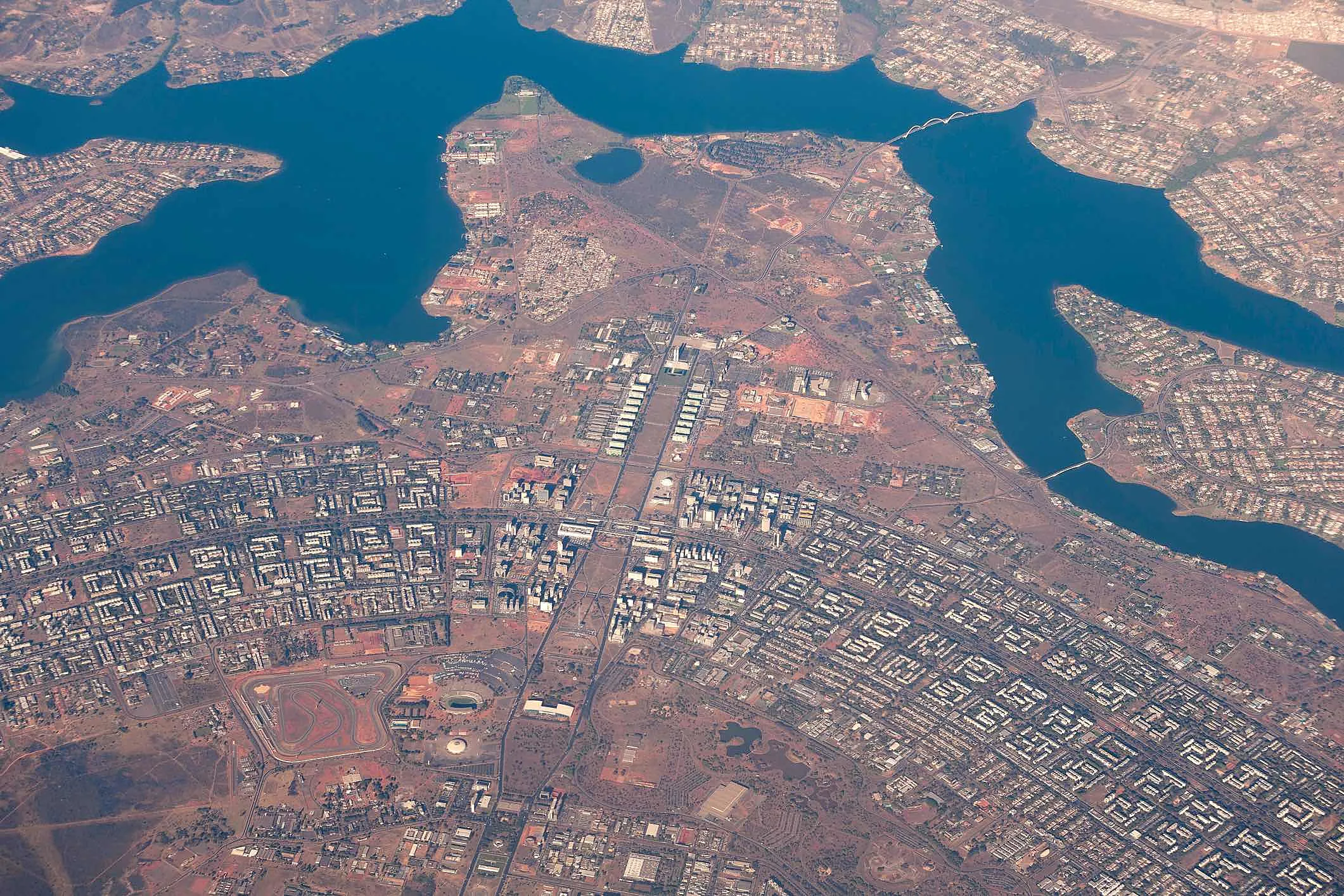
Although energy systems vary according to the climate and economy of each region, mobility remains, by a wide margin, one of the largest consumers of energy and oil worldwide.
The Invisible Infrastructure of the Automobile
During the twentieth century, the mass production of vehicles radically transformed both urban form and global energy demand. Before this expansion, cities relied primarily on trams, pedestrian networks, and compact transport systems. The arrival of the automobile shattered that logic and completely redefined the scale of modern life.
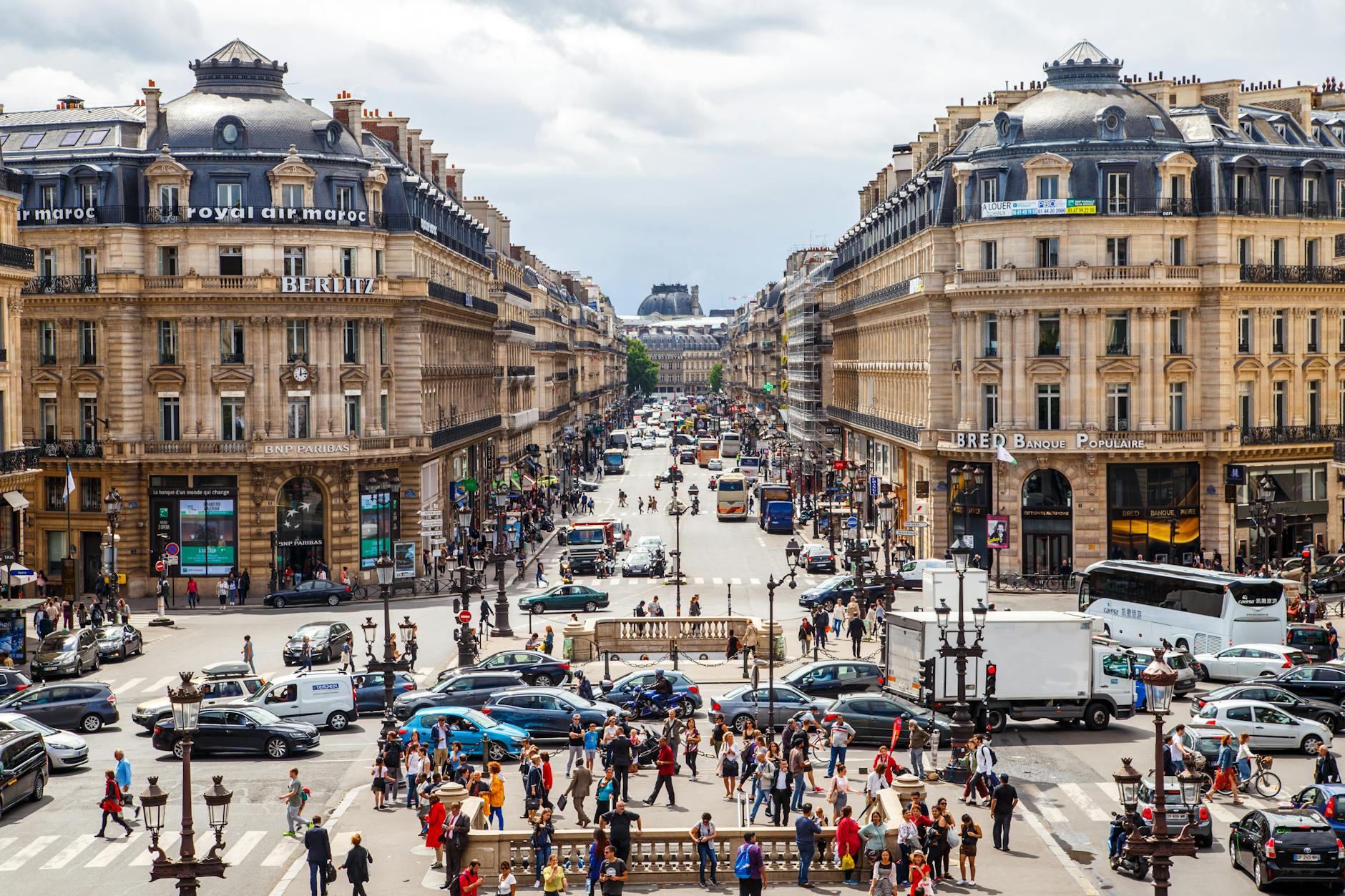
The impact, however, was not uniform. Many European cities retained their dense and compact historic centres — an urban fabric built centuries before the emergence of the motor car — which later facilitated the development of public transport networks and pedestrianised areas.
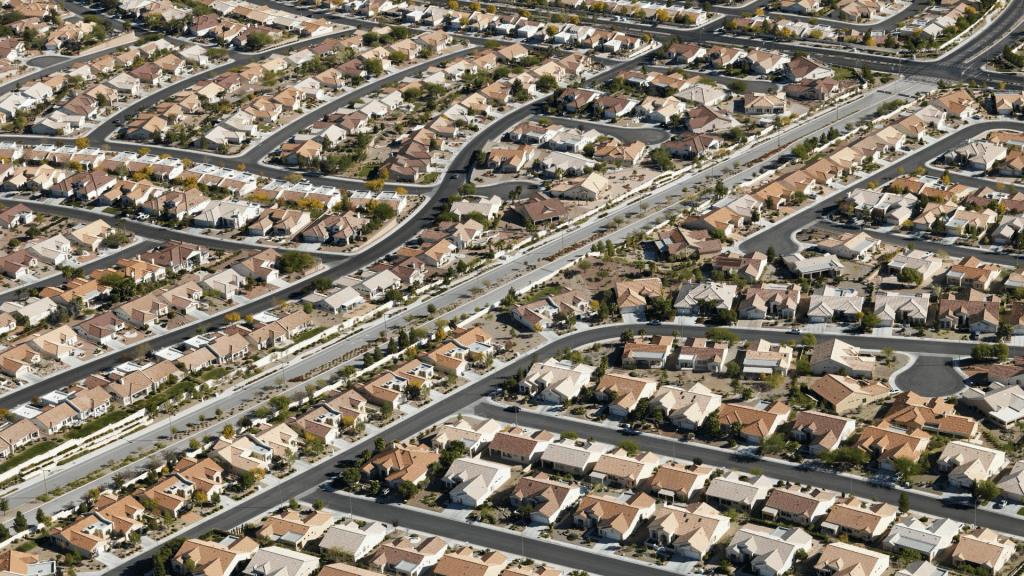
In contrast, much of North America embraced the model of suburban sprawl. Urban growth translated into vast residential zones separated from workplaces, commerce, and essential services. As distances increased and density declined, the automobile ceased to be a matter of convenience and became a necessity for everyday survival.
Cities were reorganised around asphalt, with wider roads and expanding motorway networks. In the process, a model emerged that linked the car to freedom and economic progress, yet whose operation depended on an increasingly unsustainable condition: the perpetual availability of cheap fuel.
Two Urban Models, Two Levels of Energy Consumption
A landmark study by researchers Peter Newman and Jeffrey Kenworthy found that per capita fuel consumption in North American cities was four times higher than in European cities and up to ten times greater than in Asian urban centres.
What made the findings truly groundbreaking was the discovery that this gap could not be explained by income levels or engine efficiency. According to the authors, structural variables such as urban density, land-use diversity, and public transport planning are the decisive factors behind a community’s level of energy dependence.
A Stark Contrast: New York City and Tampa
The consequences of these two opposing planning models can be seen clearly within the United States itself.
1. New York City
Consistently ranking among the highest Walk Score cities in the country, New York enables the vast majority of its residents to carry out their daily journeys either on foot or through the extensive public transport network operated by the MTA. As a direct result, New Yorkers consume significantly less fuel per capita and produce lower driving-related CO₂ emissions than the national average. This compact urban structure also acts as an economic buffer for household finances, helping to reduce the impact of volatility in global oil prices.
2. Tampa
Tampa represents the opposite side of the equation. Dispersed growth, functional segregation, and pedestrian-hostile infrastructure have turned the private car into a tool of everyday survival. In this environment, meeting basic needs — such as going to work, buying food, or accessing healthcare — requires travelling long distances by car.
Under this model of near-total automobile dependence, any increase in global oil prices immediately affects household budgets, driving up the overall cost of urban living.

Architecture, Neuroscience, and Urban Health
For decades, the impact of automobile-dependent urban models was evaluated almost exclusively through environmental and economic lenses. Today, however, disciplines such as environmental psychology and neuroscience demonstrate that the design of cities also shapes our mental health, stress levels, and the way we experience everyday life.
For millions of people, chronic traffic congestion has ceased to be a minor inconvenience and has become a constant source of physical and cognitive strain. Being trapped daily in bumper-to-bumper traffic elevates cortisol levels, disrupts heart rhythms, and triggers cognitive fatigue. By extending commuting times, this system consumes hours of life, reduces free time, and intensifies social isolation.
Extreme dependence on the automobile also transforms the everyday perception of the city. Journeys cease to be urban experiences and instead become mechanical, repetitive, and stressful processes. Rather than encouraging spontaneous encounters, physical activity, or community interaction, much of today’s infrastructure prioritises speed and traffic flow alone, subordinating human experience to the logic of congestion.
This dynamic consumes more than fuel; it also consumes attention, emotional energy, and cognitive time. Constant exposure to noise, congestion, and time pressure keeps millions of people in prolonged states of tension and silent fatigue. As urban distances increase, the everyday experience of inhabiting the city becomes increasingly fragmented.
In this context, urban planning can no longer be limited to solving how to move bodies from point A to point B. Its true mission is to understand the kind of psychological, emotional, and social experience produced by that journey. Dense, walkable cities supported by efficient public transport demonstrate that reducing dependence on the car is not merely a strategy for ecological sustainability; it is also a fundamental tool for improving public health, strengthening social cohesion, and reducing the psychological strain associated with contemporary urban life.

Conclusion: The Crisis Is Not Only Energy-Related
Global dependence on fossil fuels is not a distant problem confined to oil fields or diplomatic relations; the price of energy affects the very structure of our daily lives.
This vulnerability is embedded in the design of many modern cities, conceived under the assumption that cheap fuel would guarantee constant mobility. Today, in a context of energy inflation, geopolitical instability, and climate crisis, that model no longer serves us and increasingly exposes our fragilities.
For this reason, the great contemporary challenge is not simply to replace the combustion engine with electric vehicles. The deeper challenge lies in redesigning cities capable of reducing the constant need to travel long distances in order to work, access essential services, or participate in urban life.
Transforming the urban environment to reduce energy demand is a key strategy not only for decarbonisation, but also for strengthening economic resilience, protecting public health, and building a more resilient and humane future.
Recommended Readings
The Death and Life of Great American Cities — A foundational critique of automobile-centred planning, emphasising density, mixed-use neighbourhoods and walkable urban life.
Cities and Automobile Dependence — Landmark comparative research showing how urban density, transport systems and land-use patterns shape fuel consumption and automobile dependence across global cities.
Costs of Automobile Dependence: Global Survey of Cities — A comparative study demonstrating that sprawling, car-dependent cities tend to generate higher transportation costs, road expenditure and environmental impacts than compact urban models.
Happy City — Explores how urban design influences mental health, social interaction, mobility and everyday well-being through the lens of psychology and neuroscience.

