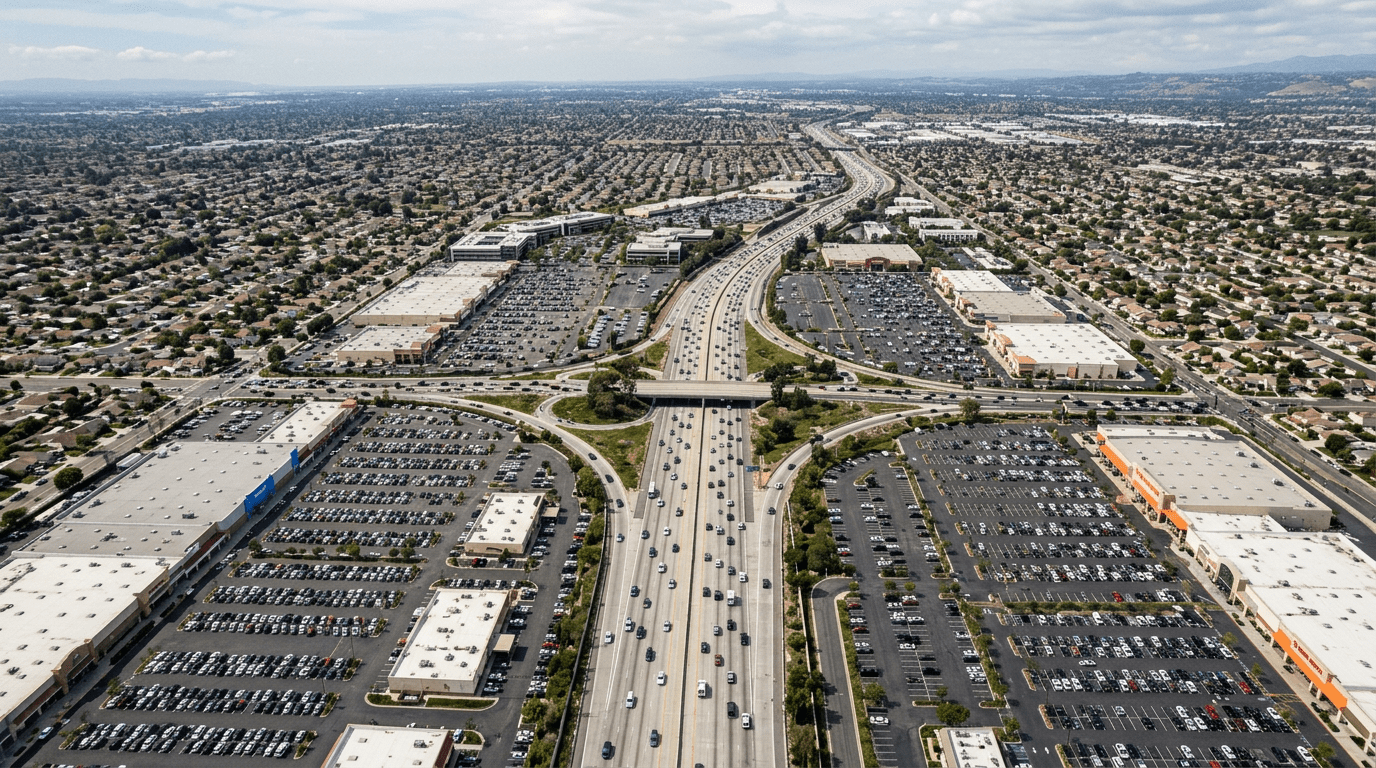
Pip: Every morning, millions of people sit in traffic doing maths they shouldn’t have to do — will the fuel money stretch to cover the school run and the groceries? That tension is exactly what this site keeps pulling at.
Mara: Patricia Fierro-Newton’s latest work asks why that tension exists in the first place, tracing it back to the decisions baked into urban form itself – how cities are shaped, how we move through them, and what that costs us in ways beyond the fuel bill. Let’s start with the relationship between urban design and energy dependence.
Energy Dependence and Urban Design
Pip: The central claim here is uncomfortable: the energy crisis isn’t something that happens to cities from the outside. It’s something cities were designed to produce. The question the post forces is whether the problem is the fuel or the layout that makes the fuel unavoidable.
Mara: The post frames this precisely – “The form of our cities dictates, directly, the amount of energy we are condemned to consume.”
Pip: Condemned is the operative word. It’s not overconsumption through bad choices — it’s overconsumption baked into the infrastructure, so that opting out isn’t really available to most people.
Mara: The research cited here makes that structural argument concrete. Newman and Kenworthy’s comparative study found that per-capita fuel consumption in North American cities was four times higher than in European ones, and up to ten times higher than in Asian cities. Crucially, the gap wasn’t explained by income levels or engine efficiency — the decisive variables were urban density, mixed land use, and public transport planning.
Pip: So Tampa versus New York isn’t a story about lifestyle choices — it’s a story about what the grid forces on you.
Mara: Exactly that. The post contrasts the two directly. New York’s compact, walkable structure means most residents commute on foot or via the MTA, which translates into significantly lower per-capita fuel consumption and CO₂ emissions. Tampa’s dispersed growth and pedestrian-hostile infrastructure mean the private car isn’t a convenience — it’s a survival tool. Any spike in global oil prices hits household budgets immediately and directly.
Pip: And the post doesn’t stop at the wallet. It brings in environmental psychology and neuroscience to argue that chronic traffic congestion elevates cortisol, disrupts heart rhythms, and produces cognitive fatigue — the city consuming not just fuel but attention and emotional energy. That’s a meaningful expansion of what we usually count as the cost.
Mara: The conclusion follows from that: the real challenge isn’t swapping combustion engines for electric vehicles. It’s redesigning cities to reduce the permanent need to travel long distances just to work, shop, or access basic services. Decarbonisation and public health turn out to be the same project.
Pip: Which means the next conversation isn’t really about energy policy — it’s about what we decide cities are actually for.
Mara: The thread running through all of this is that urban vulnerability — to energy prices, to geopolitical shocks, to chronic stress — is largely a design problem. Which means it’s also, in principle, a design solution.
Pip: Next time, we’ll see what that solution looks like when someone actually tries to build it.

