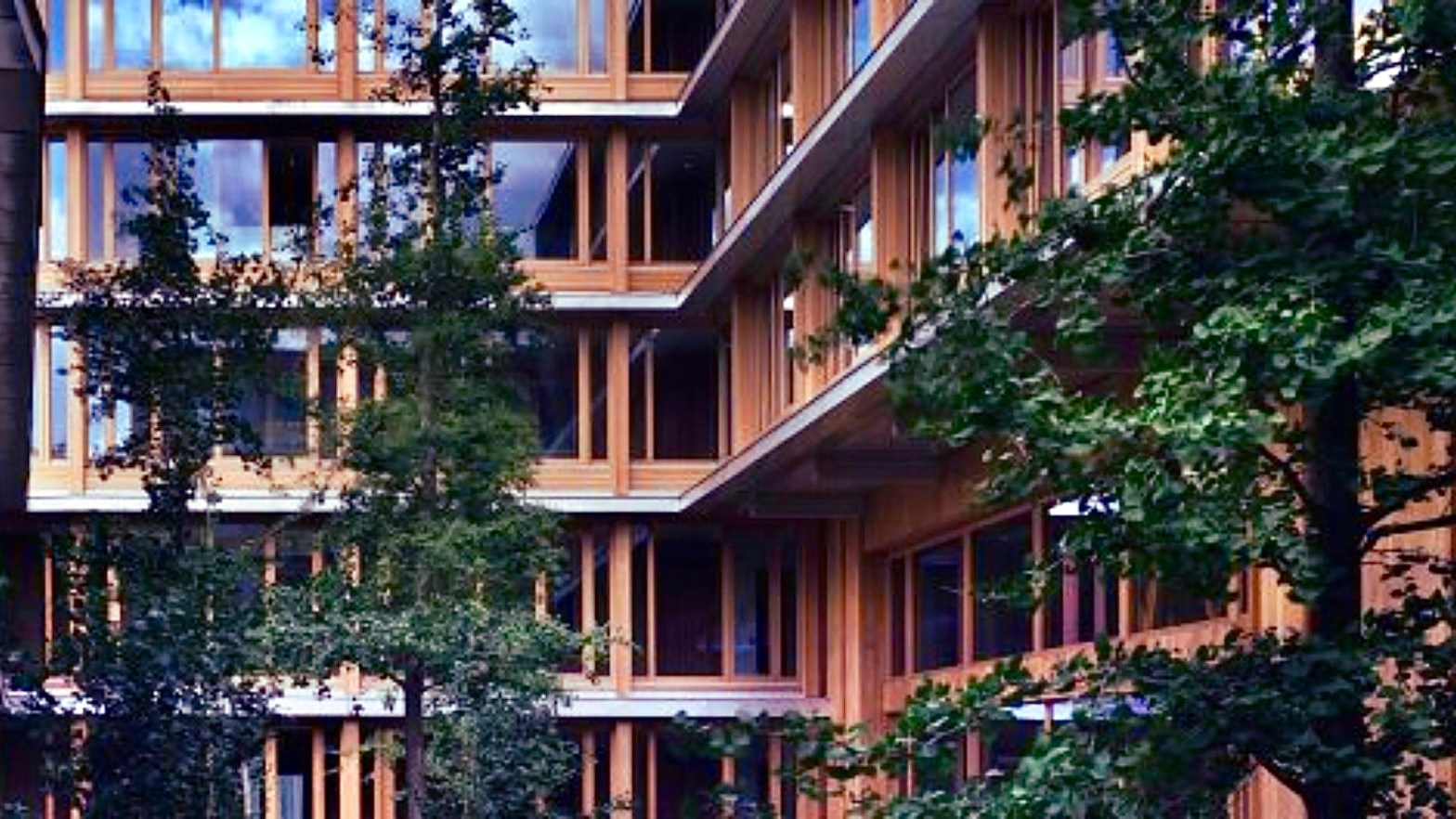
Can design prevent loneliness?
In a rapidly ageing world, this question is no longer rhetorical.
Loneliness, recognised by the WHO as one of the main threats to public health, affects memory, blood pressure, and even life expectancy.
But what if architecture could help us weave back together the bonds that time and the city have unravelled?
The answer came this year from an unexpected place: Appleby Blue Almshouse, winner of the 2025 Stirling Prize from the Royal Institute of British Architects (RIBA).
This recognition suggests a shift in paradigm: architecture is beginning to look beyond form, towards what truly matters — human wellbeing, connection, and shared life.
The United Kingdom was one of the first countries to recognise loneliness as a public health crisis, even creating a Ministry for Loneliness —a clear sign of the scale of the problem and the urgency of addressing it through design and community.
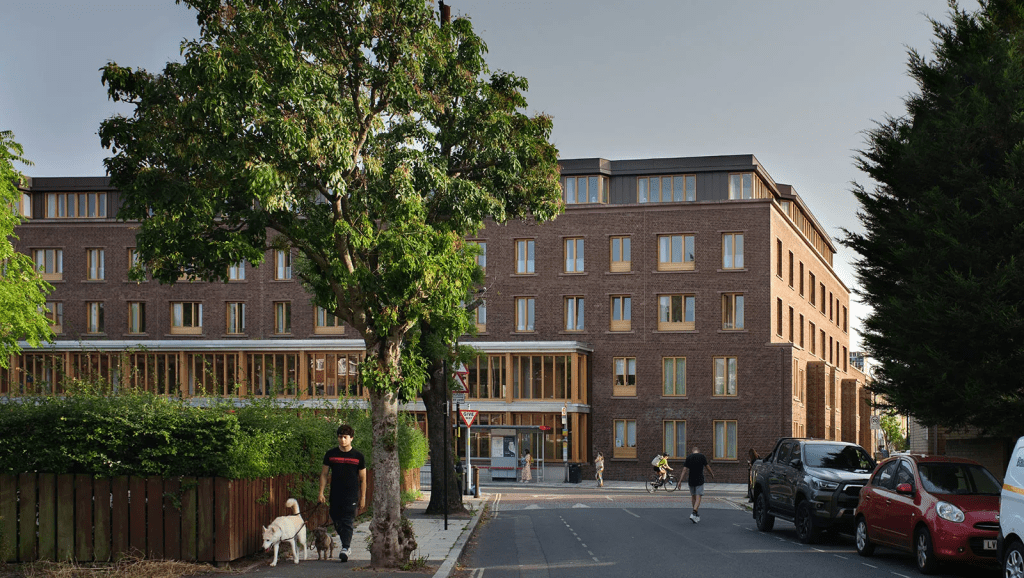
A social housing project for people over 65.
Without grandeur or dazzling technology, yet with a profoundly human idea at its core: to design in order to overcome loneliness. (Photo: Philip Vile)
The Appleby Blue Almshouse in London
On a quiet street in Bermondsey, in southeast London, a brick building opens itself to the light. From the outside it appears modest, but once you cross its threshold everything changes: corridors turn into living galleries, filled with plants, laughter, and shared silence.
This project, designed by Witherford Watson Mann Architects, does not seek to impress —it seeks to welcome and connect. Here, every detail invites you to linger, to talk, to look out of the window, and to develop a sense of belonging.
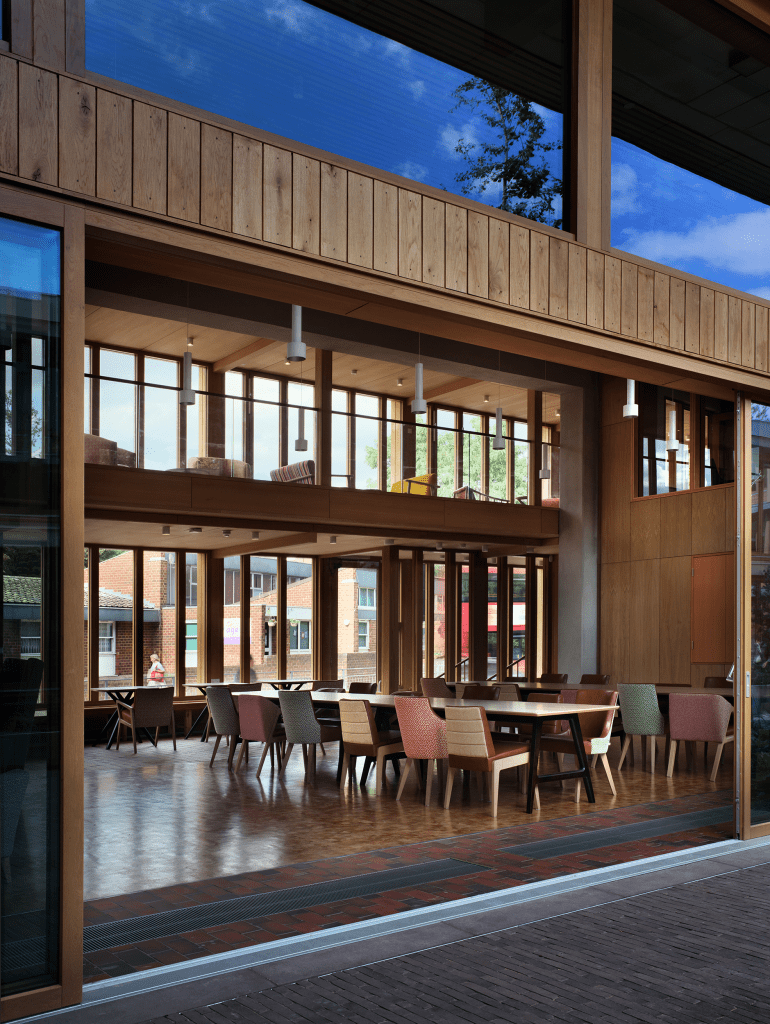
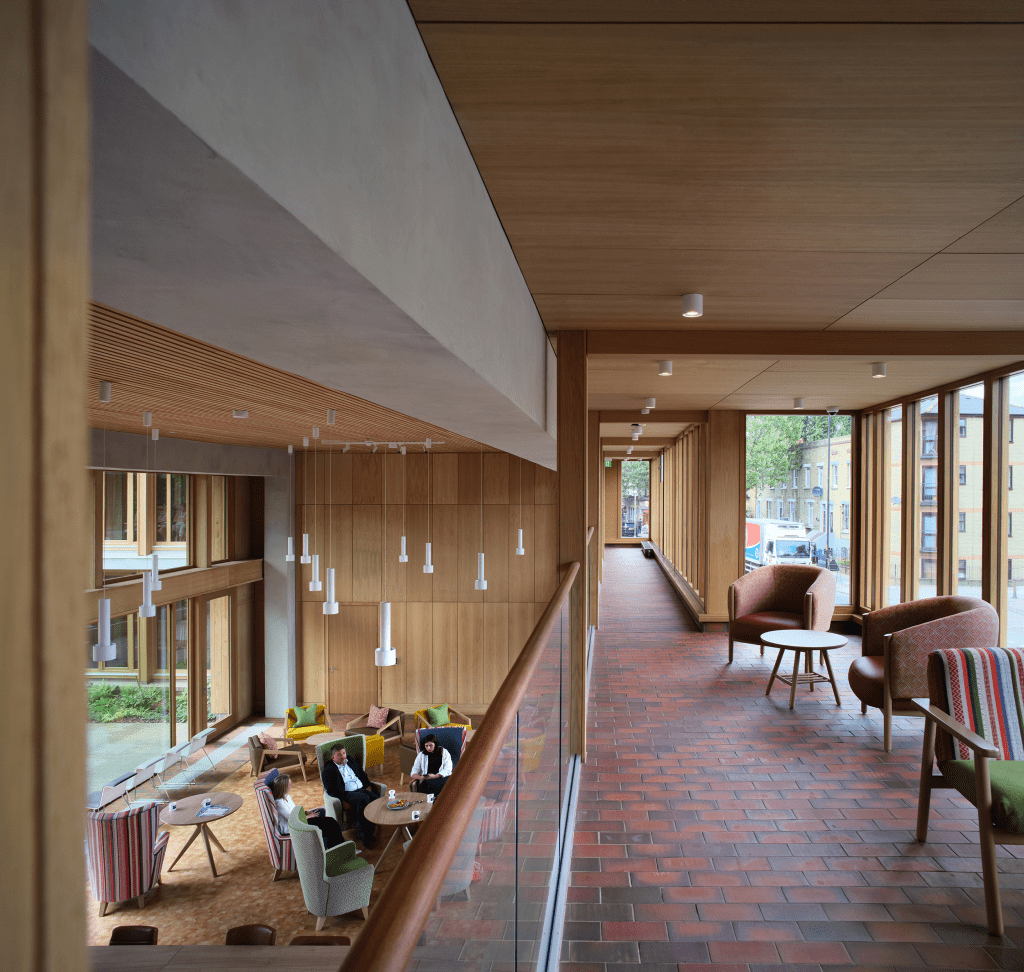
In this project, transitional spaces become places of spontaneous encounter, designed to nurture human connection and keep the mind alive.
1. Independent but Collective Living
This project reinterprets the historic English concept of the almshouse —charitable housing for older people— through a contemporary lens. Appleby Blue welcomes residents over the age of 65 with local roots, offering them independence within a network of support and belonging.
What stands out most is its participatory approach: future residents took part in the design process, expressing their wish for natural light, gathering spaces, and intermediate areas where they could feel accompanied without losing privacy.
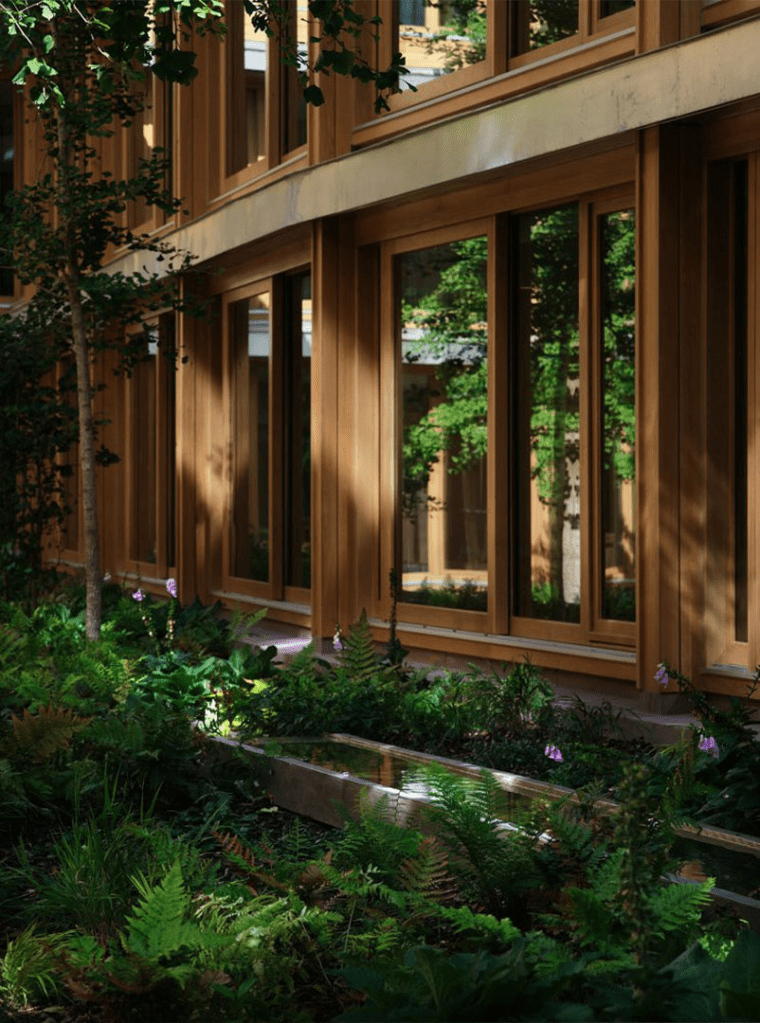
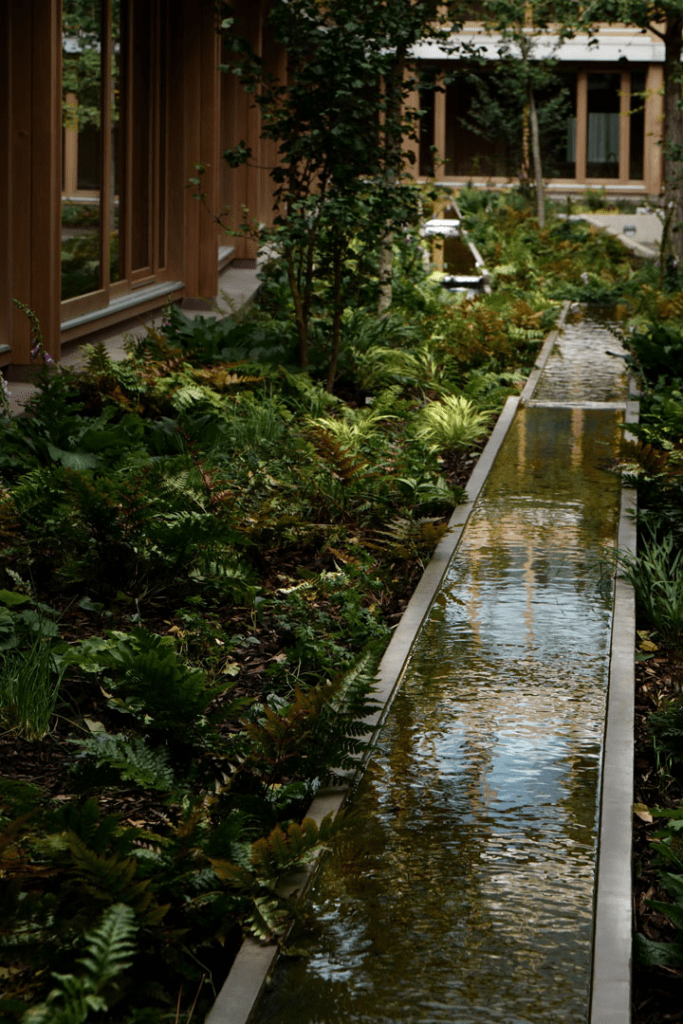
Among ferns and a slender water channel, light reflects and moves gently, creating a sensory atmosphere that invites calm and contemplation. Here, nature is not decorative —it is an essential part of the residents’ emotional and cognitive wellbeing.
2. Elements of Inclusive Design
The Appleby Blue Almshouse houses 57 apartments —51 one-bedroom and 6 two-bedroom—, each designed to provide independence without isolation.
The dwellings are arranged around a central landscaped courtyard, visible from every level, functioning as a bright, green heart where everyday life intertwines with calm.
The glazed galleries act as small interior streets: corridors filled with plants, natural light, and wooden benches that invite people to pause and converse.
At the ends, communal areas —a shared kitchen, a multipurpose room, a craft studio, and a rooftop garden— complement domestic life with opportunities for encounter and collaboration.
The materials —blue-grey brick, light wood, and ceramic— reinforce a sense of warmth and continuity with the urban fabric, evoking the industrial memory of the neighbourhood while bringing a serene, contemporary texture.
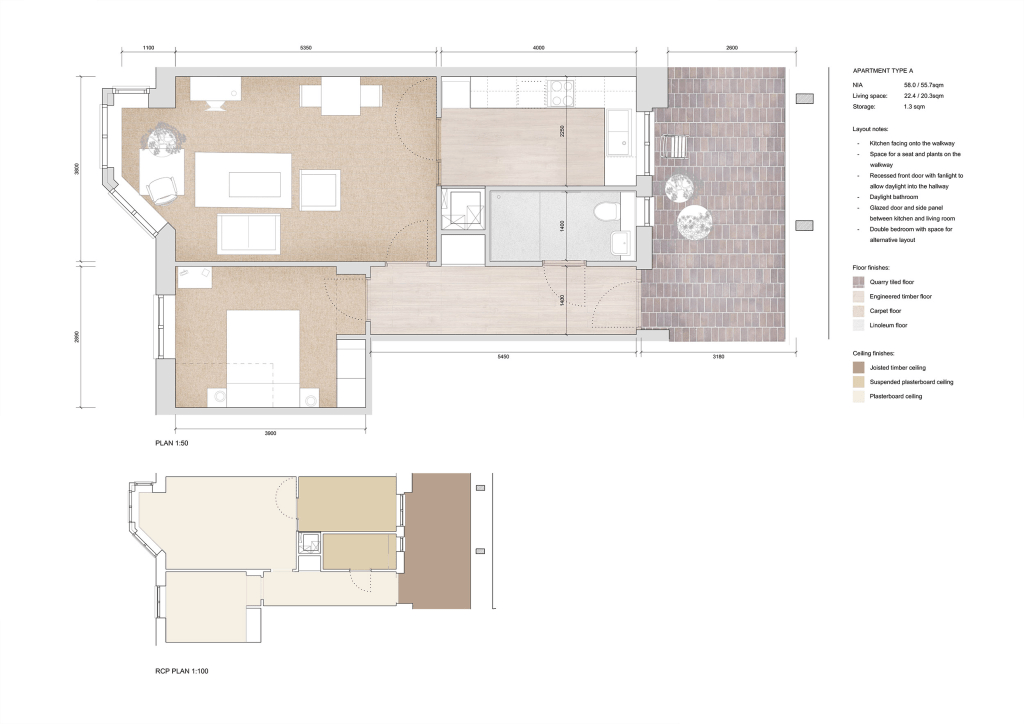
One-bedroom dwelling designed to offer independence without isolation.
The layout optimises natural light, exterior views, and connection with the corridor, integrating a small terrace that extends the domestic space towards the community. Every detail —from the warm materials to the flexibility of the furnishings— is intended to foster autonomy, sensory comfort, and everyday connection.
Social Connection as an Antidote to Alzheimer’s
Numerous studies indicate that social relationships not only make us feel good, but also activate vital areas of the brain:
- Brain Activation: Conversations and interaction strengthen the hippocampus and the prefrontal cortex, key areas for memory, orientation, and decision-making.
- Chemical Well-being: A simple empathetic glance or a moment of spontaneous conversation triggers the release of dopamine and oxytocin, the essential molecules for motivation and emotional well-being.
That is why projects like Appleby Blue Almshouse are much more than aesthetically pleasant buildings —they are infrastructure designed for brain health.
Its architecture is anything but accidental. Every element is conceived as a biological catalyst:
| Design Element | Neuroscientific Impact |
| Open courtyards and galleries | Encourage daily doses of interaction —spontaneous encounters, gestures, conversations. |
| Intermediate spaces | Create an invisible network of social support and stimulation without forcing contact. |
| Natural light and living textures | Reduce cortisol levels and strengthen neural plasticity, keeping the brain curious and alert. |
In this type of environment, community life is a daily medicine that keeps the neurons in shape.
The Final Lesson
Ageing with dignity is not only about receiving medical care —it’s about keeping the mind’s spark alive.
Perhaps the best prevention against Alzheimer’s and cognitive decline is not found solely in a laboratory, but in something far more fundamental: how we design the places where people can continue to feel seen, useful, and deeply connected.
An architecture that cares for the mind as much as the body.
What do you think? Do you know of other examples of architecture designed specifically to combat loneliness or stress? I’d love to explore more cases.
References
Witherford Watson Mann Architects. (2025). Appleby Blue Almshouse. Royal Institute of British Architects (RIBA) – London Awards 2025. https://www.riba.org/explore/awards/uk-awards/regional-awards/2025/london-awards/appleby-blue-almshouse/
BBC News. (2025, 17 de octubre). Appleby Blue Almshouse: Bermondsey homes for older people win top RIBA Stirling Prize. https://www.bbc.co.uk/news/articles/c4gwlz6k96no
Wallpaper*. (2025, 17 de octubre). RIBA Stirling Prize 2025: Appleby Blue Almshouse wins architecture’s top UK honour. https://www.wallpaper.com/architecture/riba-stirling-prize-2025-winner
World Landscape Architect. (2023, 10 de octubre). Appleby Blue reimagines the almshouse for 21st-century inner-city living. https://worldlandscapearchitect.com/appleby-blue-reimagines-the-almshouse-for-21st-century-inner-city-living/
Young, E. (2023, 10 de octubre). Appleby Blue almshouse and its residents sit firmly in the community. RIBA Journal. https://www.almshouses.org/wp-content/uploads/2023/10/Riba-Journal-Appleby-Blue-almshouse-and-its-residents-sit-firmly-in-the-community-10-10-23-Eleanor-Young.pdf
Southwark News. (2024, 15 de abril). Appleby Blue Almshouse in Bermondsey shortlisted for national housing award. https://southwarknews.co.uk/area/camberwell/appleby-blue-almshouse-in-bermondsey-shortlisted-for-prestigious-national-housing-award/
Cacioppo, J. T., & Cacioppo, S. (2018). The growing problem of loneliness. The Lancet, 391(10119), 426. https://doi.org/10.1016/S0140-6736(18)30142-9
World Health Organization. (2023). Social isolation and loneliness among older people: advocacy brief. Geneva: WHO. https://www.who.int/publications/i/item/9789240073749
National Health Service (NHS). (2024). Loneliness and mental health. https://www.nhs.uk/mental-health/feelings-symptoms-behaviours/feelings-and-symptoms/loneliness/
Office for National Statistics (ONS). (2023). Loneliness in Great Britain: 2023. https://www.ons.gov.uk
 neurotectura.com