
By looking past the myth of the “creative space”, a major 2025 review reveals how indoor environments selectively shape different modes of human thought.
Walk into the headquarters of a technology company, a design school, or a modern co-working hub, and you are likely to encounter many of the same design features: open layouts, colourful furniture, abundant daylight, indoor plants, collaborative zones, and informal meeting areas.
The underlying assumption is clear. Certain environments are believed to make people more creative. But is creativity really something that can be designed into a space?
A recent systematic review published in the Journal of Environmental Psychology examined this question by analysing 46 experiments from 34 empirical studies investigating the relationship between indoor environmental attributes and creativity. The findings reveal a more nuanced picture than many popular discussions of creativity and design suggest.
Rather than identifying a universal formula for creative environments, the review found that the relationship between indoor environmental conditions and creativity remains inconsistent and highly dependent on context.
The implication is significant for architects, educators, workplace designers, and anyone interested in neuroarchitecture: there may be no such thing as a universally creative space.
Understanding Creativity
One reason the evidence appears inconsistent is that creativity itself is often misunderstood.
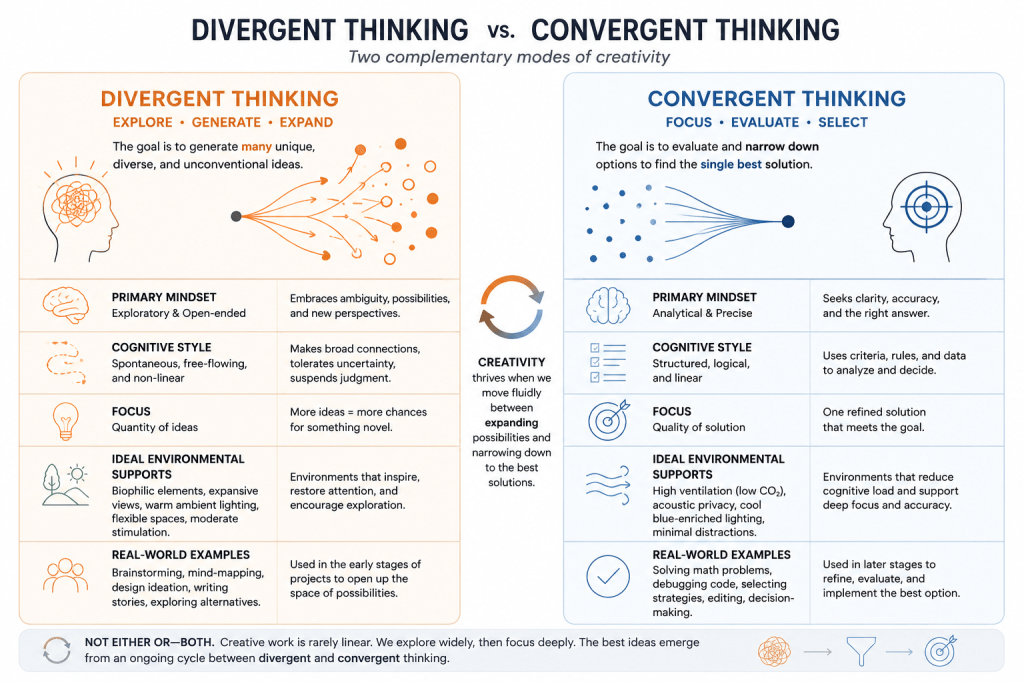
Creativity is commonly treated as a single cognitive ability, but psychologists distinguish between two different modes of thinking: divergent thinking and convergent thinking.
Divergent Thinking
Divergent thinking involves generating multiple ideas, possibilities, and novel associations. It is exploratory, open-ended, and unconstrained. This type of thinking appears during activities such as brainstorming new concepts, developing design alternatives, generating story ideas, or speculating about future possibilities. The objective is not accuracy but expansion. Divergent thinking allows the mind to move freely between possibilities without immediately filtering or evaluating them.
Convergent Thinking
Convergent thinking, by contrast, involves evaluating alternatives and selecting the most effective solution. It is analytical, focused, and goal-directed. This cognitive mode is present when solving technical problems, refining a design proposal, selecting the best strategy, or completing mathematical and logical tasks. Here, the objective is precision rather than possibility.
Most real-world creativity requires both processes. Designers, scientists, writers, and architects typically move repeatedly between generating ideas and evaluating them. This distinction turns out to be critical when assessing how environments influence cognition.
What the Research Found
The review examined a broad range of environmental attributes, including nature and indoor vegetation, window views, spatial layouts, furniture arrangements, lighting conditions, colour schemes, sound environments, indoor air quality, and socio-spatial relationships.
The most important conclusion was surprisingly simple: there is no consistent evidence that any single environmental attribute universally improves creativity.
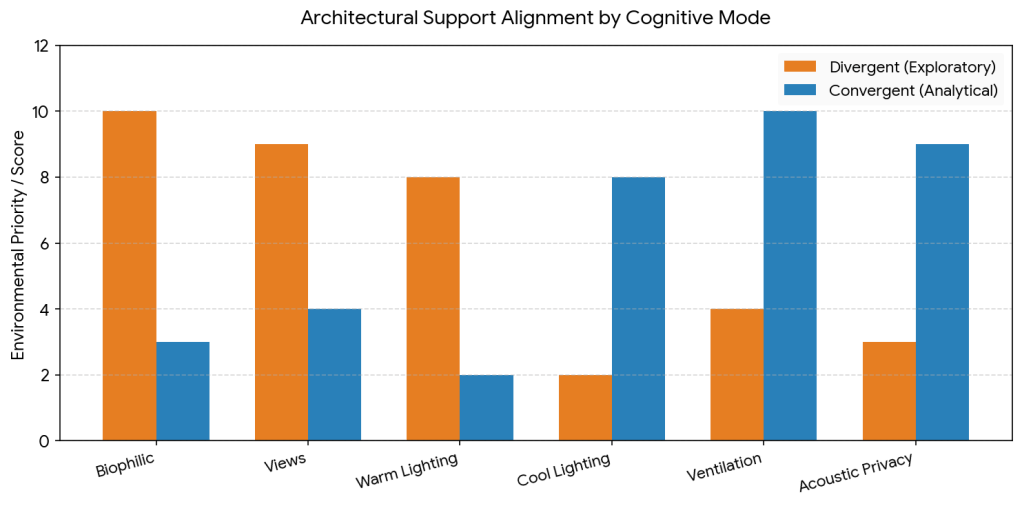
Different studies often produced conflicting results. Some environmental conditions appeared beneficial in one context and ineffective in another. More importantly, several environmental attributes influenced divergent thinking without affecting convergent thinking, or vice versa. This suggests that different cognitive processes may require different environmental conditions.
The question may therefore not be, “Does this space improve creativity?” but rather, “What type of thinking does this space support?”
Nature and the Generation of Ideas
Among all environmental variables examined, nature-related attributes produced some of the most promising results.
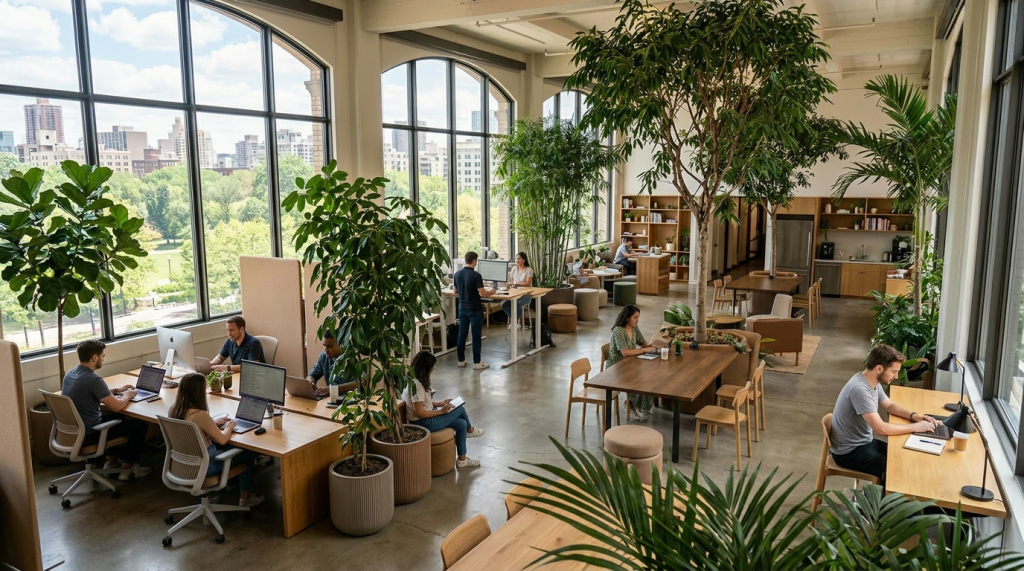
Indoor vegetation, natural views, and exposure to natural elements were repeatedly associated with improvements in divergent thinking.
Several theories attempt to explain why this may occur. Attention Restoration Theory proposes that natural environments help restore depleted attentional resources. Unlike urban environments, which demand constant directed attention, natural settings engage the mind more gently, allowing cognitive resources to recover.
Other researchers point to reduced stress, improved mood, and increased cognitive flexibility as possible mechanisms. Regardless of the precise explanation, exposure to nature appears particularly relevant during phases of idea generation rather than analytical problem-solving.
For architects and designers, this finding reinforces the potential value of biophilic design—not necessarily as a universal productivity tool, but as a support for exploratory thinking.
The Invisible Architecture of Air
While discussions of creativity often focus on aesthetics, the review highlights the importance of less visible environmental conditions.
Indoor air quality may influence cognitive performance more directly than many decorative design features. Poorly ventilated spaces can accumulate elevated concentrations of carbon dioxide, contributing to fatigue, reduced attention, headaches, and diminished decision-making performance. These effects become especially relevant in densely occupied classrooms, offices, and meeting spaces where ventilation is insufficient.
Similarly, exposure to airborne particulate matter has been associated with inflammation, cognitive decline, and reduced mental performance. Increasingly, researchers are linking long-term exposure to polluted indoor and urban environments with neuroinflammation and impaired memory.
These findings suggest that creativity cannot be separated from fundamental physiological conditions. Before considering colour palettes or inspirational furniture, designers may need to address ventilation, filtration, thermal comfort, and access to fresh air.
The brain is a biological organ before it is a creative one.
Light, Alertness, and Mental Performance
Lighting also influences cognition, although the relationship is more complex than often assumed.
Natural daylight helps regulate circadian rhythms through specialised retinal cells that communicate directly with the brain’s biological clock. Exposure to daylight supports alertness, emotional regulation, memory, and overall cognitive functioning.
Research on artificial lighting suggests that colour temperature may also affect mental states. Cooler light tends to promote alertness and focused task performance, while warmer light is associated with relaxation and reduced physiological arousal.
However, the relationship between lighting and creativity remains far from settled. Some studies suggest that moderate lighting conditions may support creative ideation better than either extreme stimulation or excessive relaxation. Researchers have even proposed nonlinear relationships between colour temperature and creativity, suggesting that both overly cold and overly warm environments may impair cognitive flexibility.
Again, the evidence points away from universal design prescriptions and towards contextual adaptation.
Why the Evidence Remains Inconclusive
Perhaps the most valuable contribution of the review is methodological.
Many earlier studies investigating creativity and space relied heavily on self-reports, interviews, supervisor evaluations, and perceived creativity rather than objective cognitive measurements. Far fewer studies measured creativity through task-based assessments capable of isolating specific cognitive processes.
As a result, much of the existing literature reflects perceptions of creativity rather than demonstrated creative performance.
The authors argue that future research should employ more rigorous experimental designs, including objective cognitive tasks, controlled environmental conditions, and long-term studies.
For neuroarchitecture, this is an important reminder. The field is evolving from broad assumptions about environmental influence toward more precise investigations of how specific design variables affect particular cognitive processes.
Towards Neurodiverse and Adaptive Environments
One of the most intriguing implications of this research concerns individual differences.
The same environment may support creativity for one person while distracting another. This is especially relevant when considering neurodiversity.
An open-plan office that encourages spontaneous interaction may stimulate idea generation for some individuals while overwhelming others who require sensory predictability and reduced distractions. Similarly, highly stimulating environments may benefit exploratory thinking while undermining deep concentration and sustained attention.
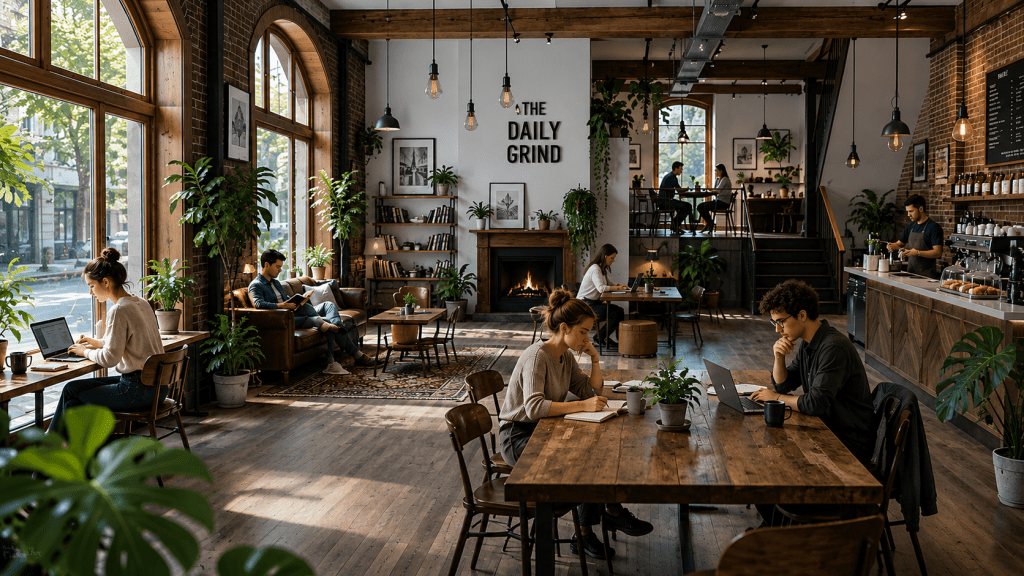
Rather than searching for universally optimal environments, designers may need to create adaptable environments that support transitions between different cognitive states.
Creative work rarely occurs in a single mode. Neither should creative spaces.
Conclusion
The idea that architecture can influence creativity remains compelling, but the evidence suggests a more sophisticated reality than many popular narratives imply.
Indoor environments do not appear to enhance creativity in a universal or predictable manner. Instead, different environmental conditions may support different forms of thinking, influence individuals in different ways, and interact with cognitive processes that are themselves highly complex.
The most creative spaces may not be those that attempt to stimulate creativity directly. They may be those that offer people the environmental flexibility to move between exploration and evaluation, imagination and analysis, divergence and convergence.
In other words, the future of creativity-centred design may not lie in creating spaces that make people creative but in creating spaces that support the many different ways humans think.
Recommended reading
Rhee, J. H., Park, S. Y., Han, G., Schermer, B., & Lee, K. H. (2025). Role of indoor environmental attributes on creativity: A systematic review. Journal of Environmental Psychology. https://doi.org/10.1016/j.jenvp.2025.102499
Csikszentmihalyi, M. (1996). Creativity: Flow and the psychology of discovery and invention. HarperCollins.
Guilford, J. P. (1967). The nature of human intelligence. McGraw-Hill.
Runco, M. A., & Jaeger, G. J. (2012). The standard definition of creativity. Creativity Research Journal, 24(1), 92–96. https://doi.org/10.1080/10400419.2012.650092
Amabile, T. M. (1983). The social psychology of creativity. Springer-Verlag.

