
Stress is a necessary biological response that allows us to react, adapt and survive in a constantly changing environment. When the brain perceives a threat — whether real or symbolic — it activates the nervous system and releases hormones such as cortisol and adrenaline, preparing the body to respond quickly.
This reaction, known as the fight-or-flight response, is essential in situations of danger. It increases heart rate, mobilises energy and sharpens attention. The problem is not its activation, but its persistence. In the contemporary world, many threats are abstract: work pressures, economic uncertainty, relational conflict. The alarm system is triggered, yet it rarely reaches a clear resolution.
When this state of activation is prolonged, the body pays the price. Anxiety, sleep disturbances, irritability and cardiovascular disease are among its manifestations. Chronic stress is no longer merely an individual experience; it has become a public health issue affecting entire communities.
If stress is biological, regulation is biological too. And in that process of regulation, the environment plays a quiet yet decisive role.

Vision and the Need for Horizon
We are visual creatures. It is estimated that around 80% of the information processed by the brain comes through sight. Through vision, we do not merely perceive shapes and colours; we interpret distance, depth, movement and light. Sight does more than register surfaces — it continuously evaluates the environment in terms of orientation and safety.
For thousands of years, the human visual field was directed towards open horizons, natural variations of light, and movement unfolding at multiple scales. Our nervous system evolved in constant dialogue with the outdoors. The sky, vegetation, and the rhythm of day and night functioned as essential spatial and temporal references.
When that visual communication is reduced — when the gaze ends on a nearby wall, or artificial lighting erases the natural passage of the day — the brain loses fundamental cues. Visual depth and contact with exterior elements are not merely aesthetic qualities; they have measurable physiological and psychological effects.
A recent experimental study examined how different visual compositions in window views influence 27 physiological and psychological indicators related to attention, emotion and stress. Rather than classifying views as simply “natural” or “non-natural”, the researchers distinguished three components — sky, buildings and green space — and assessed their proportions.
The findings showed that views with a greater presence of sky or vegetation, as well as those that balanced all three elements, produced stronger restorative effects: improved attentional recovery, reduced negative emotions, and lower stress markers.
Not all windows regulate us in the same way. The visual composition of the landscape matters.
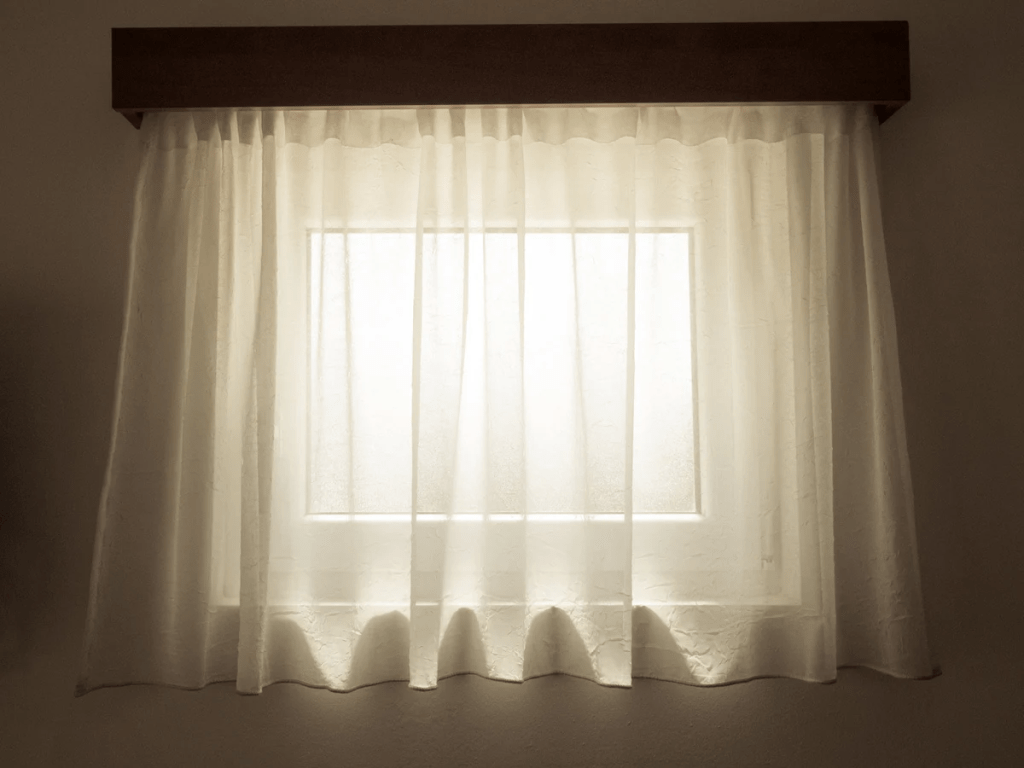

Neither the small window that removes the horizon nor the unfiltered expanse of glazing guarantees wellbeing. Regulation emerges when light, depth and refuge find balance.quilibrio.
When the Window Does Not Regulate, but Exposes
More openness does not automatically translate into greater wellbeing.
Windows that are too small can restrict the visual field, reduce the perception of depth and block the spatial references necessary for orientation. When the gaze consistently ends on a nearby surface, spatial experience becomes compressed. The absence of horizon and natural light variation can contribute to a subtle sense of confinement.
Yet the opposite extreme is not inherently regulating either.
Large expanses of glazing without intermediate filters may trigger a different form of activation: loss of privacy, overexposure and a feeling of vulnerability. The nervous system does not seek prospect alone — the ability to see into the distance — but also refuge.
This idea was articulated by the geographer Jay Appleton in his Prospect–Refuge theory (1975), which proposes that environments most comfortable for human beings combine the capacity to observe with the ability to feel protected. From an evolutionary perspective, safety emerges from the balance between seeing without being entirely seen.
When a home becomes a permanent display case, the body may remain in a state of subtle vigilance. The absence of clear boundaries can interfere with our sense of control over personal space.
Regulation, therefore, does not depend on the size of the window, but on the quality of mediation: what is seen, how much is seen, from where it is seen, and under what conditions.
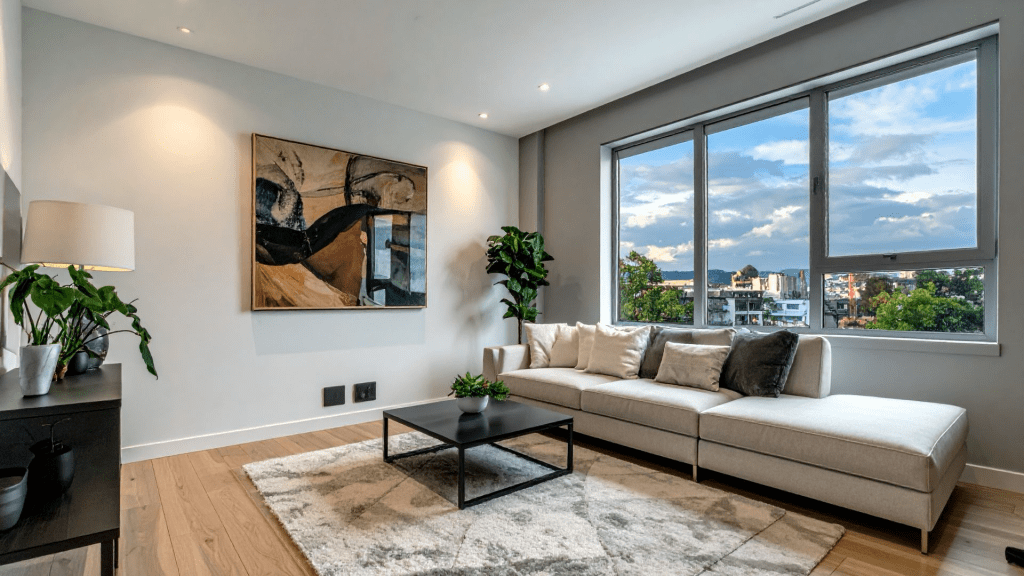
A window that offers depth and sky from within a contained interior. When the gaze can expand without losing the sense of refuge, the space does more than illuminate — it regulates.
More Than an Opening
These findings reinforce an intuition many of us recognise at a subjective level: not all windows offer the same experience. It is not merely about creating an opening in a wall; it is about enabling a balanced visual relationship with the outside.
The horizon regulates when there is depth without excessive exposure.
When there is sky, but also boundaries.
When the gaze can extend outward without the body feeling vulnerable.
If stress activates the nervous system in response to context, architecture forms part of that context. Perhaps the real question is not how much light enters a space, but what kind of visual relationship we are constructing between the interior and the world beyond.
Sometimes, the difference between remaining on alert and regaining equilibrium does not lie in eliminating stress — an impossible task — but in offering the body clear references of orientation, depth and refuge.
And that can begin with something as ordinary — and as decisive — as the way we design a window.
References
Appleton, J. (1975). The experience of landscape. Wiley.
The experience of landscape. (1975). Landscape Research, 1(10), 15–16. https://www.tandfonline.com/doi/abs/10.1080/01426397508705780
Ulrich, R. S. (1984). View through a window may influence recovery from surgery. Science, 224(4647), 420–421. https://doi.org/10.1126/science.6143402
Kaplan, R., & Kaplan, S. (1989). The experience of nature: A psychological perspective. Cambridge University Press.
Zhang, X., Chen, Y., Li, D., & Sun, Y. (2024). Effects of different window view compositions on attention restoration, emotional state, and stress recovery: An experimental study based on physiological and psychological indicators. https://doi.org/10.1016/j.scs.2024.105293
Recommended Reading
Glass houses: how much privacy can city-dwellers expect? https://www.theguardian.com/cities/2019/feb/20/glass-houses-how-much-privacy-can-city-dwellers-expect
 neurotectura.com