
Architectural style and order are often used interchangeably, defining the visual identity of the ancient Greco-Roman style. Yet beneath the stone, geometry, and visual harmony lies something far older than any architectural tradition: the human brain, seeking patterns that transform uncertainty into understanding.
We often tell architectural history as a parade of styles. Egypt was monumental. Gothic aspired toward the heavens. Baroque sought movement and emotion. Modernism embraced abstraction and efficiency. Social, political, and economic shifts explain why styles change.
Yet style alone cannot explain why some environments feel intuitive, restorative, and emotionally comfortable while others leave us mentally exhausted.
Beneath stone, geometry, and ornament lies something older than architecture itself: the human brain—a predictive organ that constantly searches for patterns to reduce uncertainty and make sense of the world.
Architecture is more than just different styles; it reflects how we process uncertainty to survive. It serves as an extension of our thinking, helping us organise space into clear shapes. This transforms confusion into environments that we can understand, navigate, and feel comfortable in.
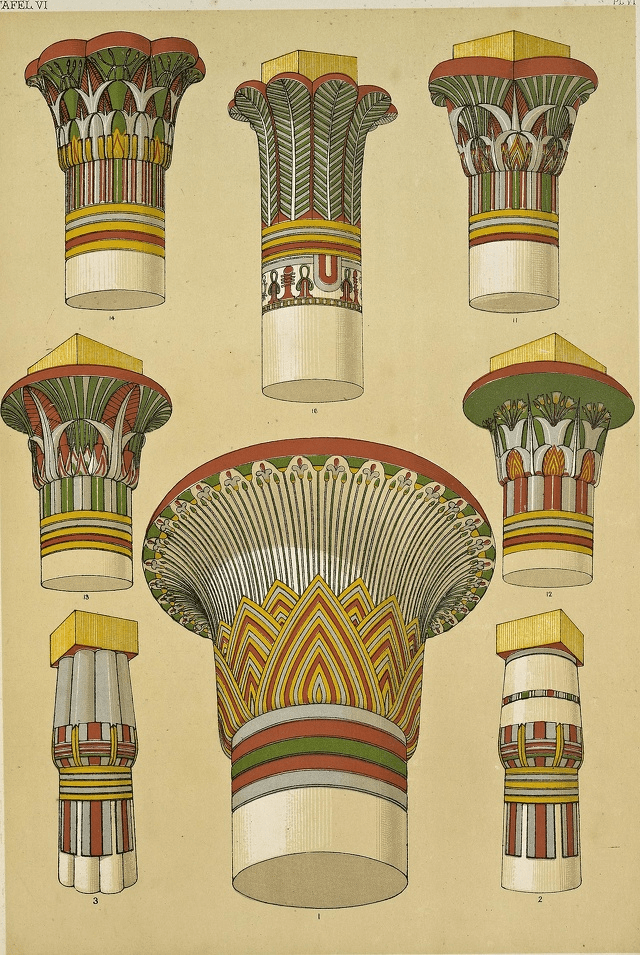

Egyptians developed some of the earliest systematic uses of columns, capitals, and architraves, drawing inspiration from natural forms such as papyrus, lotus, and palm plants. Through trade and cultural exchange across the Mediterranean, these architectural concepts influenced later Greek builders, who transformed them into the highly codified Doric, Ionic, and Corinthian Orders. While the forms evolved, the underlying goal remained the same: creating coherent, legible systems of architectural order.
The main job of the brain is to keep us alive by adapting to a changing world. Efficient environmental interpretation saves mental energy, enabling more focus on possible opportunities or threats.
The Brain as a Predictive System
Contemporary neuroscience describes the brain as a predictive organ. By building mental models of the world, it reduces uncertainty and guides action. That work has a metabolic cost. Chaotic environments drain mental energy because the brain must resolve ambiguity. Structured, orderly, and legible environments are processed more easily, freeing cognitive bandwidth and producing a sense of comfort or familiarity.
This is perceptual fluency: the relative ease with which the brain processes organised information compared to disordered stimuli.
The late environmental psychologist Dr Stephen Kaplan argued that human preference depends on two factors: legibility, how easily we understand a space, and coherence, how well its components fit together through patterns.
Dr Yannick Joye, a pioneer in evolutionary aesthetics, showed that architectural order based on natural geometries taps pre-existing neural shortcuts. Our visual cortex processes these patterns pre-attentively, reducing mental fatigue.
But fluency alone does not explain architectural experience. From this perspective, order becomes more than aesthetic preference. It becomes a tool that helps the predictive brain anticipate what comes next, lowering unnecessary cognitive effort while preserving enough novelty to sustain attention.
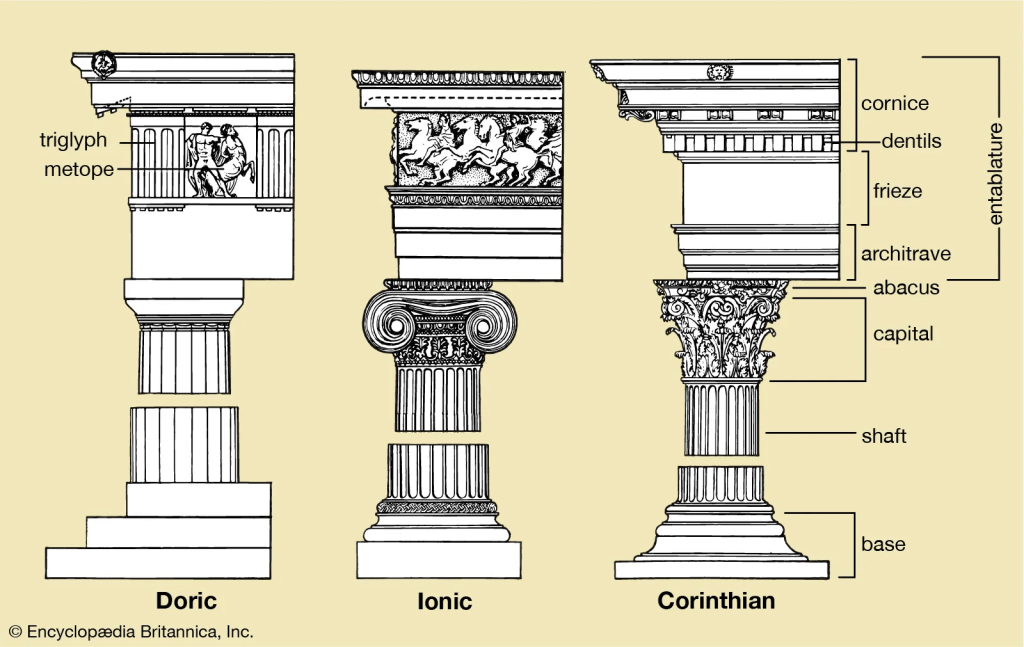
This set of rules reveals that architectural order is more than symmetry alone. Each is a carefully structured system of proportions, components, and decorative rules that transforms individual elements into a coherent, legible system.
Order, Complexity, and the Aesthetic Threshold
Research in environmental psychology and neuroaesthetics increasingly suggests that human preference does not lie at the extreme of order. Instead, it tends to emerge in the interaction between order and complexity.
Too little order produces disorientation and stress. Too much order, when reduced to repetition without variation, can result in perceptual fatigue or disengagement (monotony). The most engaging environments tend to combine coherence with richness—structure with subtle variation.
Natural systems provide a useful reference point. Landscapes, vegetation, and geological formations often display hierarchical organisation: repeating patterns at multiple scales but never perfect symmetry. Architecture across cultures appears to echo this principle in different ways, translating natural complexity into built form while preserving legibility.
Across traditions, then, architecture may be understood less as the pursuit of order alone and more as the calibration of a threshold between predictability and discovery.
Classical Architecture: Human-Scaled Order
In Classical Greek architecture, order is grounded in proportion, balance, and human scale. The Doric, Ionic, and Corinthian systems are not arbitrary decorative codes but structured proportional relationships designed to produce visual harmony.
Here, architecture is closely aligned with anthropocentric logic. The building reflects the human body and human perception, creating a sense of stability and intelligibility. Columns, entablatures, and façades form a system that can be grasped intuitively, allowing the observer to navigate space with immediate cognitive ease.
This is a form of order rooted in the measure of the human proportions.
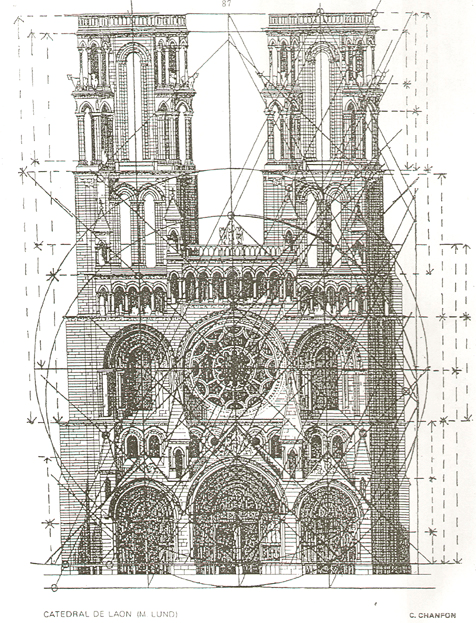
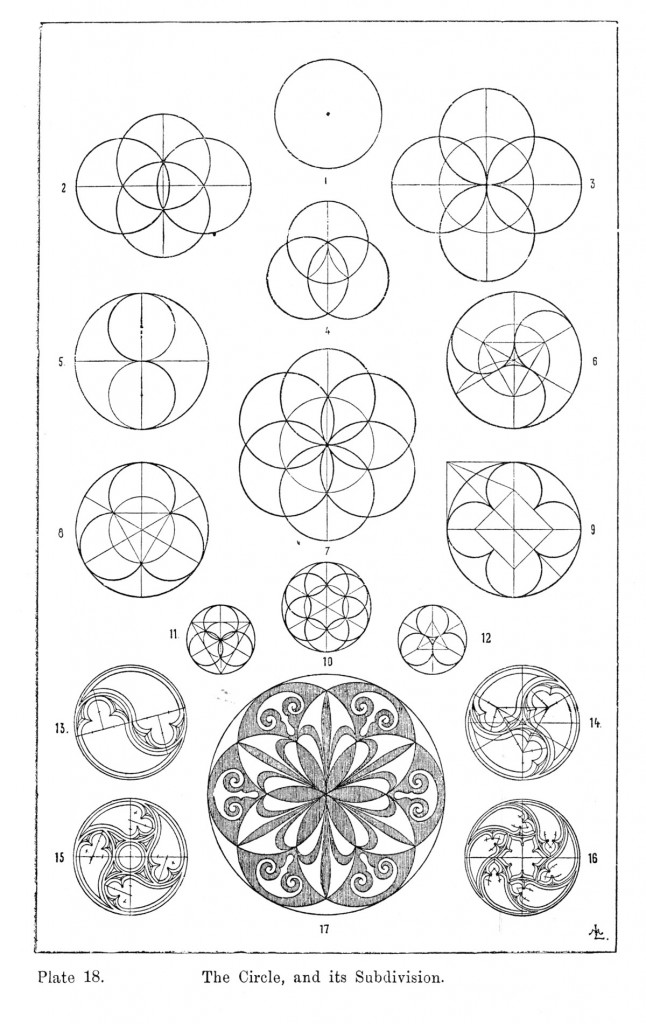
Left: Geometric analysis of Laon Cathedral’s west facade, ca. 1200, showing ad quadratum and ad triangulum proportioning. Right: Plate 18, “The Circle and its Subdivision”, the geometric vocabulary behind Gothic tracery and rose windows. In Gothic architecture, geometry was theology: a visible system of order orientated toward the infinite.
Gothic Architecture: Transcendent Order
Gothic architecture is often misinterpreted as a break from order, when in fact it represents a different conception of it.
Rather than being anthropomorphic, Gothic architecture is cosmological and theological. Its proportional systems are frequently derived from geometric constructions such as squares, circles, and triangles, often structured through ad quadratum and ad triangulum principles.
The result is not chaos but a highly disciplined spatial logic orientated toward transcendence rather than human scale.
Where classical architecture stabilises perception horizontally, Gothic architecture reorganises it vertically. The eye is drawn upward through layered structural rhythms: pointed arches, ribbed vaults, and soaring spires create a sense of ascent.
Crucially, Gothic architecture maintains internal coherence while expanding perceptual scale. It offers order that is legible at multiple levels simultaneously: structural, symbolic, and experiential.
This order is orientated not towards the human-centred concept but towards the ideas of the infinite, transcendence and awe.

Gian Lorenzo Bernini, St. Peter’s Square, 1656–1667. The ellipse, trapezoidal forecourt, and radiating travertine lines aren’t decoration. They’re geometry weaponized for perception. The colonnades “embrace” the visitor while correcting perspective on Michelangelo’s dome. Symbolism: the arms of the Church. Effect: controlled tension, movement, and sensory immersion — Baroque order manipulating the brain’s need for legibility.
Baroque and Neoclassicism: Emotional and Rational Recalibration
The Baroque period intensified the architectural experience of classical elements through curvature, spatial drama, and visual complexity. Rather than abandoning order, it manipulated it—introducing controlled tension, movement, and sensory variation.
This produced environments that are highly structured yet emotionally dynamic, engaging attention through contrast, shadow, and spatial rhythm.
Neoclassicism, by contrast, represents a recalibration toward clarity and restraint. Inspired by Enlightenment ideals and archaeological discoveries, it sought to restore formal legibility through symmetry, proportion, and geometric stability.
Together, these movements illustrate not opposition, but oscillation: architecture continually adjusts the balance between perceptual stability and sensory engagement.

Daibutsuden, Tōdai-ji, 1709. Seven ken wide, each ken a measure derived from human proportion. Japanese architecture uses the ken to organize space with clarity and variation. The result is order the mind can inhabit: repetitive but never reductive, because scale, material, and shadow change at every level.
East Asian Traditions: Modular Continuity and Environmental Harmony
In East Asian architecture, order often emerges through modular repetition and spatial sequencing rather than monumental singularity.
The Chinese jian system and the Japanese ken grid establish environments based on standardised spatial units. These systems generate clarity through rhythm and repetition, producing large-scale coherence without sacrificing adaptability.
In traditional Japanese interiors, this logic is refined further. The tatami grid structures space with quiet precision, while techniques such as shakkei (borrowed scenery) extend perception beyond built boundaries, integrating natural complexity into architectural framing.
Here, order is not imposed upon nature but aligned with it.
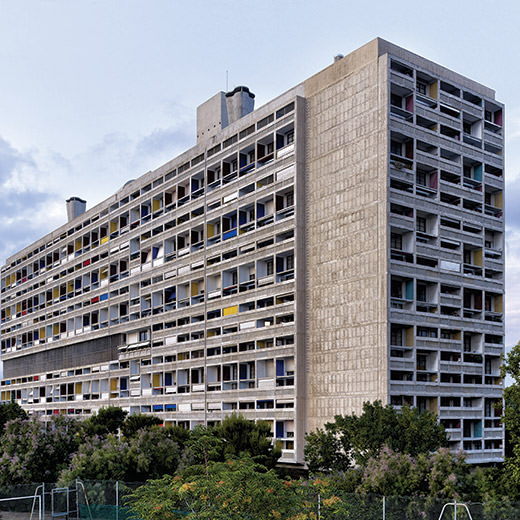

Left: Le Corbusier’s Unité d’Habitation, 1952. Proportion, colour, and pilotis create a “vertical garden city” — a modernist order that retains human scale, shadow, and sensory variation. Right: Later Brutalist housing echoes the grid but sheds hierarchical detail. Both are rational systems, yet only one balances coherence with complexity. When scale and texture disappear, the brain must work harder to structure experience.
Modernism and the Question of Reduction
Twentieth-century modernism introduced a radical simplification of architectural language, driven by industrial materials, functional efficiency, and new spatial ideologies.
In its most thoughtful expressions, modernism achieved profound clarity, spatial openness, and material honesty. However, in its more repetitive and commercially driven forms, it often reduced environments to uniform surfaces and repetitive geometries with limited sensory variation.
However, the problem was never simplicity itself. It was the loss of richness. When the brain can’t find cues in scale, texture, or detail, spaces become harder to read. Mental effort goes up.
That sterility pushed architecture toward postmodernism. The new style brought back history, colour, and symbolism. It layered memory and irony onto the modern grid to make space legible and engaging again because the mind needed complexity too.
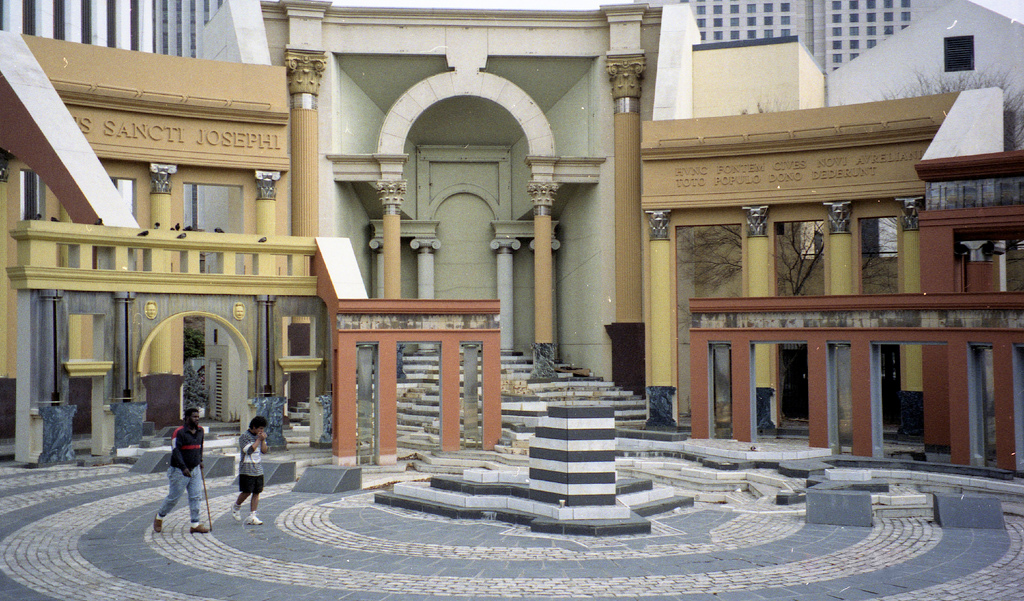
Piazza d’Italia, New Orleans, 1978. Charles Moore assembles Roman columns, Renaissance inscriptions, and Italian map motifs into a fountain plaza. He layers classical syntax, pop color, and regional symbolism to reintroduce richness lost in late Modernism. Concentric paving and axial arches provide coherence. Material jokes and scale shifts provide mystery. The result engages attention but raises cognitive load — an order that asks to be decoded, not inhabited.
Final thoughts
The brain did not evolve to passively observe the world or to create magnificent architecture. Its primary task is to anticipate, adapt, and guide action in an environment filled with change and uncertainty. Throughout human history, architecture has served as one of the tools through which we have shaped that uncertainty into something we can survive, and thrive in.
From the axial temples of Ancient Egypt to the modular courtyards of East Asia, architectural traditions have developed remarkably different spatial languages. Yet many converge on a single objective: creating environments that are protective, legible, and engaging. Whether through proportion, geometry, rhythm, symbolism, or connection to nature, these systems transform space into something the mind can understand and inhabit with confidence.
The human brain seeks patterns it can recognise in the forms of plants, animals, and the body. Through mathematics and geometry, we turn that instinct into walls, columns, and materials. Architecture is cognitive calibration: a way of aligning the built environment with the perceptual and psychological needs of the human mind.
Perhaps the most enduring architectural traditions are not those that achieve perfect order but those that maintain this delicate equilibrium: offering enough structure to orient us and enough richness to keep us curious.
Recommended Reading
Learning from Las Vegas — Robert Venturi, Denise Scott Brown & Steven Izenour.
A landmark critique of orthodox Modernism, arguing that symbolism, complexity, and everyday environments are essential components of meaningful architecture.
A Pattern Language — Christopher Alexander, Sara Ishikawa & Murray Silverstein.
A timeless exploration of recurring spatial patterns that make places more comfortable, legible, and humane.
Architecture and the Brain — John P. Eberhard.
One of the foundational books connecting architecture with neuroscience.

