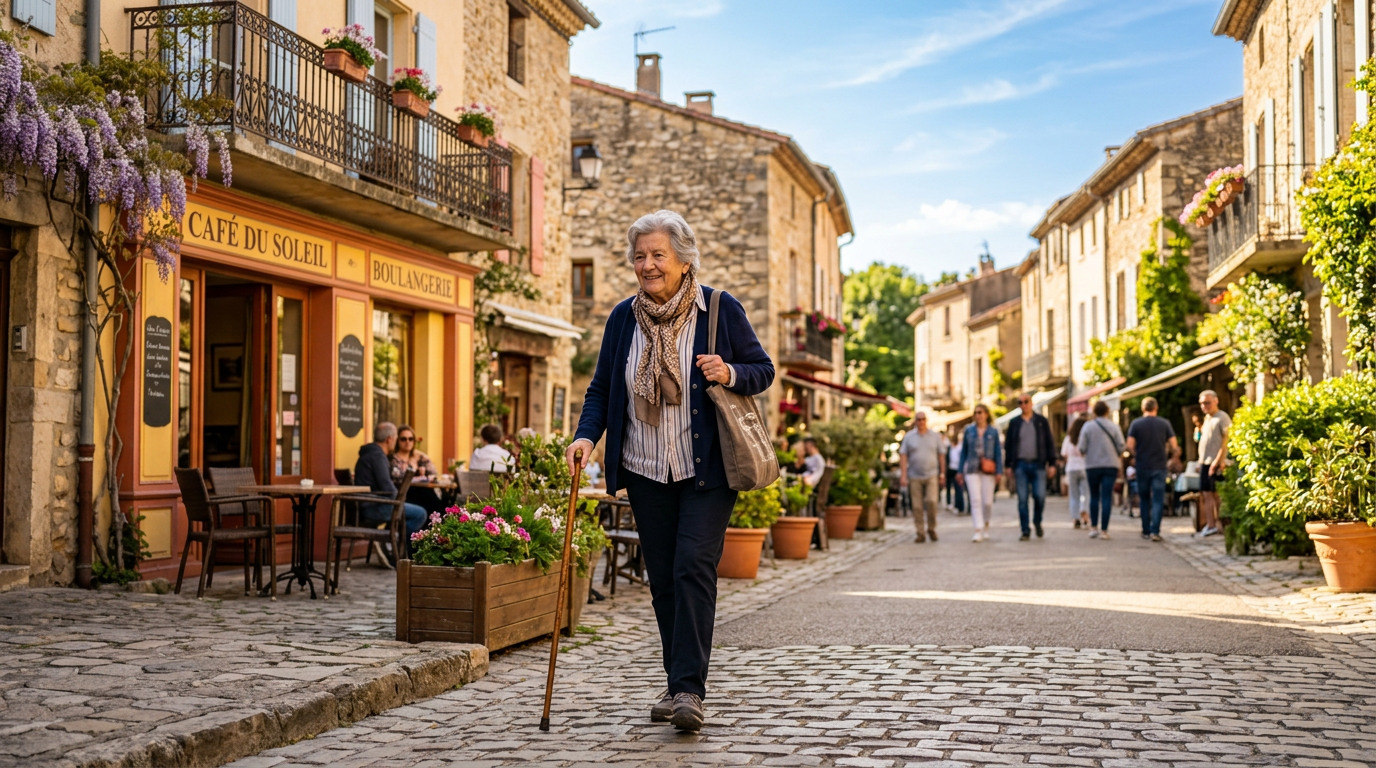
Population ageing is one of the most profound demographic transformations of the 21st century. According to World Health Organization (WHO) data, the proportion of the world’s population over 60 will double between 2020 and 2050, rising from 12% to 22%.
This phenomenon is particularly critical in industrialised nations: in Europe, 25% of the population is already over 60, while in Japan, the figure is close to 30%. In light of this reality, urban walkability is no longer an architectural luxury; it is an urgent public health necessity and a critical component of healthy brain ageing.
For millions of older adults, ageing is not simply a biological process. It is also an environmental experience shaped by the streets they walk, the places they visit, and the opportunities they have to remain connected to their communities.
As we previously highlighted in our analysis, Streets for People: The Case for Walkable Cities, returning the streets to pedestrians is the first step towards reversing the impact of cars on our physical and mental health.
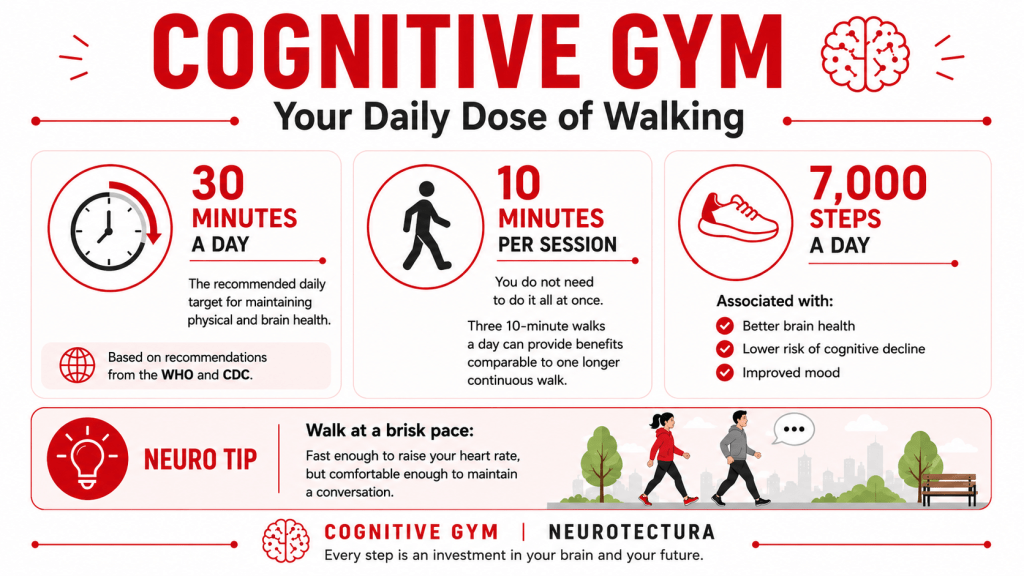
The Moving Brain: Neuroarchitecture Against Mental Decline
From the perspective of neuroarchitecture, walking through the city is not just physical exercise; it is an experience of environmental cognitive stimulation. The human brain evolved in motion. For thousands of generations, navigating, exploring, and moving around were fundamental parts of daily life.
A sedentary lifestyle breaks this ancestral relationship with our surroundings. When we stop walking, we do not just reduce physical activity; we also diminish the opportunities for exploration, social interaction, and cognitive stimulation that keep the brain active throughout life.
As we age, the brain experiences a gradual loss of volume and plasticity. However, the combination of walkability and intelligent urban design combats cognitive decline through specific neurological mechanisms:
- Hippocampal Stimulation: Walking through urban environments with high “legibility” (easy to map mentally) activates the brain’s place and grid cells, strengthening cognitive reserve and helping to reduce the risk of cognitive decline.
- Reduction of Cognitive Load: Chronic exposure to stressful urban environments may contribute to elevated cortisol levels, which have been associated with hippocampal atrophy over time.
- Enriched Environment Hypothesis: Pavements flanked by vegetation (biophilia), subtle architectural variations, and harmonious visual stimuli provide enriched cognitive stimulation that promotes brain plasticity and contributes to mental well-being in older age.
- Attention Restoration: Walking along green urban corridors allows directed attention mechanisms to rest, reducing mental fatigue and improving concentration and mood in older adults.
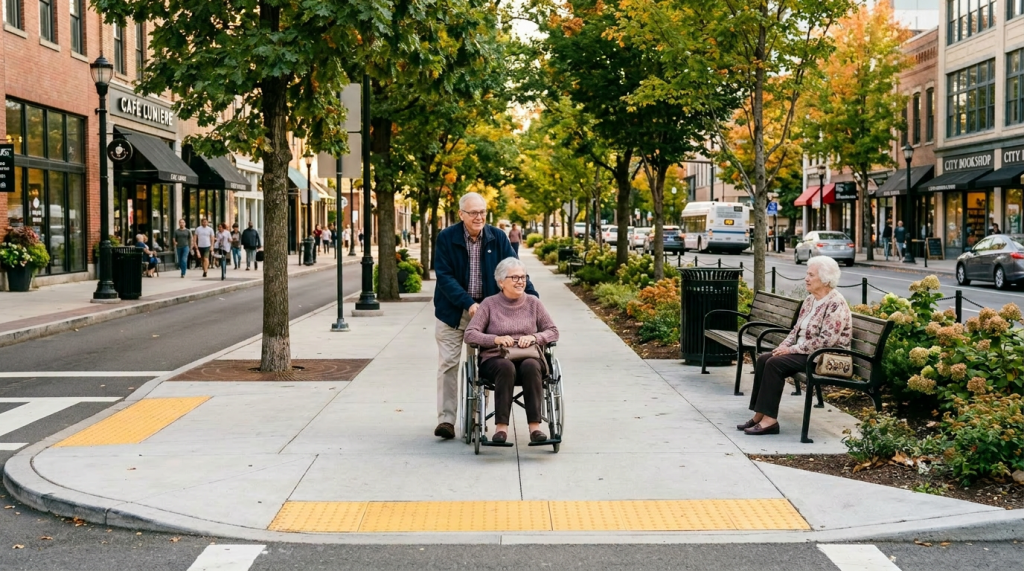
Wide pavements, accessible crossings, shade, greenery, and places to rest can make all the difference between isolation and participation, especially for older people.
The Antidote to Loneliness and Dependency
The true value of a walkable city lies in its ability to preserve the dignity and independence of older people. When a neighbourhood is designed on a human scale, older residents can go to the supermarket, visit the GP, or pick up a newspaper without relying on a car or a carer.
This constant flow of movement fosters casual encounters in squares, cafés, and parks. By stepping outside, older adults interact with their neighbours, reinforcing their sense of belonging and directly combating chronic loneliness and social isolation. This becomes particularly vital as the old-age dependency ratio in OECD countries is projected to rise from 33 to 55 older individuals for every 100 workers over the next 30 years.
The Anatomy of a Nervous System-Friendly Neighbourhood
For an urban environment to act as a cognitive ally and reduce the biological stress of an older person, it requires highly precise design criteria. In fact, a study published in the scientific journal Sustainable Cities and Society on ScienceDirect demonstrates empirically, through GPS tracking data, that spatial configuration and the visual pleasure of the journey are the factors that most influence the mobility decisions of older adults.
Based on the evidence from this study and the principles of neuroarchitecture, a healthy neighbourhood for mental longevity must integrate five crucial elements:
- Impeccable pavements: Smooth, wide, and obstacle-free surfaces that reduce the fear of falling, a factor that triggers anxiety and isolation.
- Resting spaces: Benches and seating distributed at short distances that send a safety signal to the brain: “You can explore; there is a place to recover.”
- Safe crossings: Pedestrian traffic lights programmed with longer timings, adapted to a slower walking pace to prevent situations of urban panic.
- Proximity services: The “15-minute city” model, where shops, health centres, and green spaces are nearby, reducing spatial planning fatigue.
- Predictable public infrastructure: Clean, accessible public toilets and shaded areas that minimise environmental uncertainty and user stress.
Case Study: Paris and the “15-Minute City” Revolution
This paradigm shift has a specific name and a real-world laboratory. Championed by urbanist Carlos Moreno and firmly adopted by the Paris Mayor’s Office, the “15-Minute City” project proposes decentralising metropolises so that any citizen can meet their basic needs—housing, work, health, shopping, education, and leisure—within a quarter of an hour on foot or by bicycle.
By converting spaces previously reserved for vehicular traffic into dynamic pedestrian thoroughfares, Paris aims not only to reduce carbon emissions but also to return the city to a human scale. Instead of a hostile environment that isolates vulnerable populations, neighbourhoods are redesigned as accessible and safe mosaics.
From the perspective of neuroarchitecture, the systematic pedestrianisation of historic Parisian streets represents a direct intervention in cognitive well-being. As shown in the image below, calming traffic, providing streets with shared mobility systems, and concentrating local services like cafés and local markets eliminates the bombardment of acoustic and visual stressors that overload the nervous system.
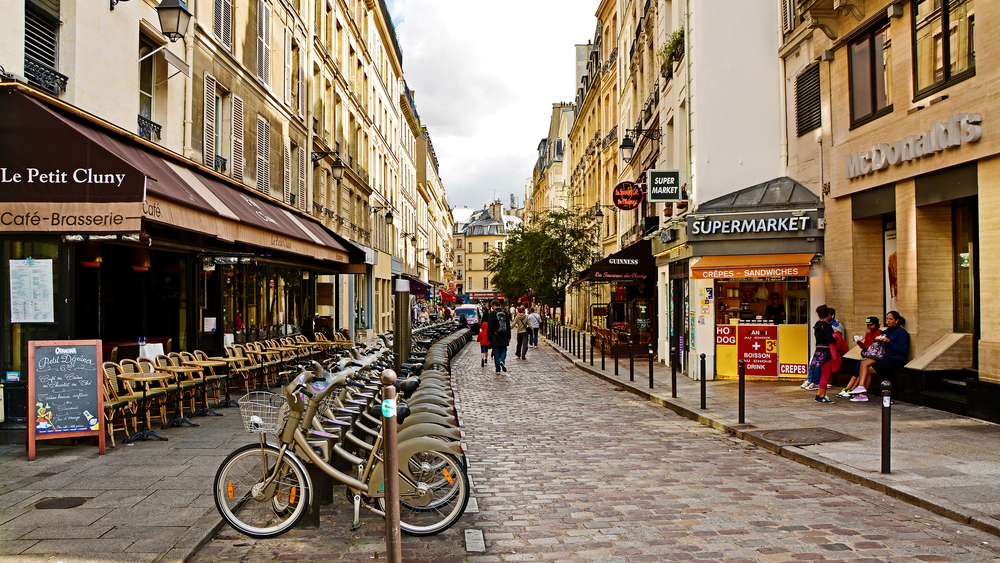
An example of how removing vehicular traffic and concentrating proximity services reduces cognitive load and returns space to the community.
For an older adult, this predictable and enriched environment functions as an open-air “neurological gym”: it radically reduces the fear of falling, stimulates spatial navigation through the hippocampus, and multiplies casual encounters, shielding the brain against loneliness and mental decline.
Conclusion: Designing for Older People is Designing for Everyone
Investing in walkable cities based on neuroarchitectural criteria is a win-win strategy for the whole of society. Globally, the fastest-growing demographic is those aged over 80. This group is projected to triple by 2050, exceeding 426 million people.
A cracked pavement or a poorly signposted crossing is not just an infrastructure failure. These are architectural barriers that stress the nervous system and accelerate cognitive isolation.
Conversely, an urban environment that is safe and stimulating for an 80-year-old is equally so for an 8-year-old child or a parent with a pushchair.
Although this article focuses on ageing, many of these principles also benefit neurodivergent individuals, children, and anyone who experiences sensory or cognitive challenges in the built environment.
Designing accessible urban environments is not merely an act of empathy. It is the smartest investment for building a society with healthier, more integrated, and longer-living brains.
🧠 Support NeuroTectura
If you found these insights on neuroarchitecture valuable and want to support the creation of spaces that reduce stress and boost well-being, consider buying me a coffee. Your support keeps this research moving forward!
 neurotectura.com
One thought on “Neuroarchitecture: How Walkable Cities Fight Cognitive Decline”