
Same classroom. Same teacher. Same curriculum. Yet the outcomes can be remarkably different.
Why?
We often look for explanations in teaching methods, motivation, ability, or family circumstances. While these factors matter, they do not tell the whole story. Learning is not an isolated cognitive event; it emerges from the continuous interaction between a learner’s brain, body, and surroundings.
No two students experience the exact same room. Bright lighting might help one student remain alert but leave another utterly overwhelmed. Background conversation can stimulate one learner while making it impossible for another to track the teacher’s voice. An open, colourful classroom might encourage exploration for one child, while triggering visual distraction, uncertainty, or sensory fatigue in another.
Because different brains perceive, filter, and respond to environmental stimuli differently, every student operates under unique cognitive demands. The classroom is not simply a passive container for education; it actively participates in the learning process.
Learning Does Not Happen Independently of Place
Learning fundamentally relies on attention—the ability to select relevant information while filtering competing stimuli—and memory—the capacity to retain and retrieve information. Environmental conditions can influence how effectively both processes operate.
A 2022 systematic review by Mar Llorens-Gámez and colleagues examined how design variables in real or simulated indoor environments were associated with attention and memory. Although the review addressed learning spaces, the selected studies were not limited to school classrooms or school-age participants. Attention and memory were assessed using psychometric, physiological and neurophysiological methods, including EEG, fMRI and heart-rate variability.
Of the 164 publications initially examined, only 14 met the review’s inclusion criteria. This scarcity is revealing: despite longstanding assumptions about how classrooms affect concentration and learning, relatively little research has objectively investigated how physical space influences attention and memory.
The review grouped the evidence into six broad environmental categories:
- Form and Geometry: Rectilinear versus curvilinear shapes and spatial complexity.
- Spatial Distribution: How a classroom is organised and how easily its layout is understood.
- Colour and Texture: The hues, contrasts, and materials that create the visual character of the room.
- Dimensions and Enclosure: Ceiling height, width, and the feeling of openness versus confinement.
- Transitions and Circulation: How learners enter, exit, and physically move through the space.
- Environmental Conditions: The interplay between lighting, noise, and temperature.
Across the selected studies, differences in these variables were associated with changes in measures of attention, memory and physiological arousal. The findings suggest that learning-space design can influence how cognitive resources are allocated. However, the small evidence base, varied methods and limited participant diversity mean that these findings cannot yet be translated into universal design prescriptions.
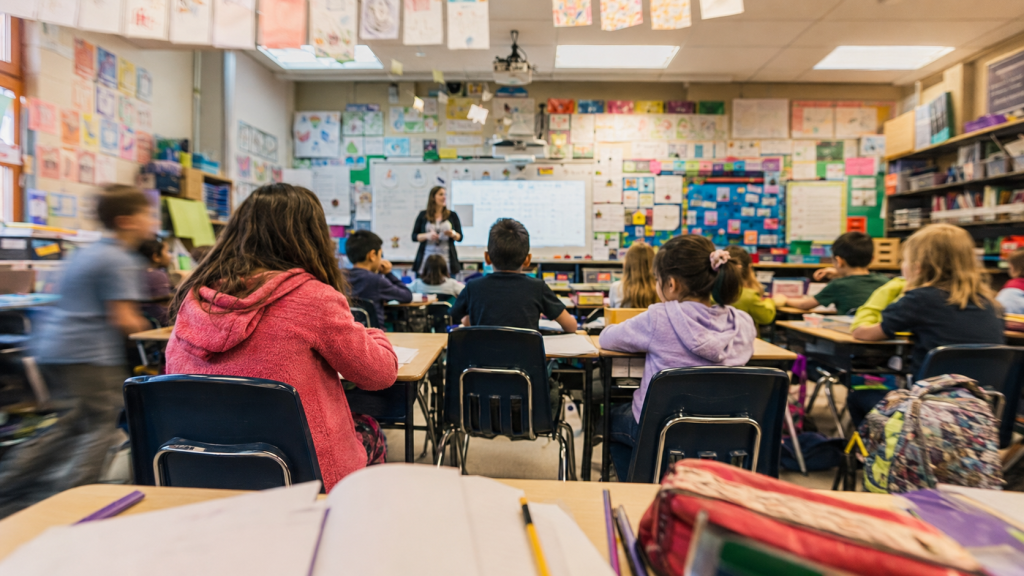
Dense displays, lighting glare, movement and competing visual information increase cognitive effort. For some children with ADHD, this can make attention harder to regulate; for some autistic children, the accumulated sensory input may become overwhelming.
The Missing Learner
Before translating these findings into classroom design, we need to ask a fundamental question: whose brains have actually been studied?
A 2025 review by Erminia Attaianese, Morena Barilà and Mariangela Perillo analysed 27 articles examining neuroscientific approaches to architectural research. The authors found that much of the research relied on controlled or virtual environments, with relatively few studies conducted in real-world settings. They also identified a strong bias towards young, healthy and often Western participants, with limited representation of disabled people and others who may experience the built environment differently.
Although the review did not focus specifically on neurodivergent students, its criticism has direct implications for education. Findings derived from narrow participant groups cannot automatically be assumed to represent autistic learners, students with ADHD or children with different sensory and cognitive profiles. When design recommendations are based on an assumed average response, the learners most affected by environmental conditions may remain least represented in the evidence.
The Neurodivergent Experience: When the Environment Demands Too Much
The interaction between cognition and environment may be particularly consequential for neurodivergent learners. Autism and ADHD are both associated with differences in sensory processing and attention regulation, although these differences vary considerably between individuals. There is no single autistic or ADHD response to a classroom.
The nervous system does not process every sound, movement or visual detail equally. It continuously prioritises certain signals while reducing awareness of others. These filtering and regulatory processes differ between individuals: a stimulus that remains in the background for one student may repeatedly capture another student’s attention.
Research involving autistic learners describes both heightened and reduced responses to sensory input, as well as differences in disengaging, shifting attention and filtering competing auditory and visual information. An integrative review by Mallory and Keehn (2021) suggests that some autistic learners may process more task-irrelevant information alongside what they are expected to focus on.
This should not be understood simply as a filter that has “failed”. Greater perceptual sensitivity may support strengths, such as noticing details or performing well in particular visual-search tasks. In a busy classroom, however, processing more of the surrounding information can also increase the cognitive effort required to identify what matters, sustain attention and participate in learning.
- The Cumulative Sensory Environment
The hum of ventilation, fluorescent lighting, chairs scraping against a hard floor, nearby conversations and unpredictable physical contact can create a continuous stream of competing information. For a sensory-sensitive learner, repeatedly monitoring or responding to these stimuli may require cognitive and emotional resources that would otherwise be available for the lesson.
This burden is not always visible. A student may appear inattentive, withdrawn, restless or uncooperative when they are attempting to regulate their response to the environment.
- Visual Complexity and Attention
Classrooms are often filled with posters, hanging artwork, brightly coloured displays and visible storage. These elements may communicate creativity and achievement, but they can also compete with educational material for attention.
A small experimental study involving kindergarten children—not specifically children with ADHD—found that highly decorated classroom walls were associated with more off-task behaviour and smaller learning gains than a less decorated environment. The finding should not be treated as an argument for empty classrooms, but it raises an important question: which visual information supports the current activity, and which information merely competes with it?
For learners who already experience difficulties regulating or directing attention, unnecessary visual competition may create an additional demand on working memory.
- Predictability, Movement and Retreat
For some autistic learners, clear spatial organisation, recognisable transitions and consistent environmental cues can make the classroom easier to understand and anticipate. Predictability is not the same as rigidity. It means that learners can identify where activities take place, understand how to move between them and prepare for changes.
Other students may need movement to regulate alertness and sustain attention. A classroom that requires every learner to remain in one position for long periods may inadvertently increase the effort needed to participate. Flexible seating and opportunities for movement may help, although the evidence remains limited and individual preferences must guide their use.
Access to a quieter or less stimulating area is equally important. Retreat should not function as punishment or exclusion but as an ordinary option for regulation before sensory demand becomes overwhelming.

Designing for Learning, Not for an Average Learner
None of this means that a particular wall colour, ceiling height or geometric form will automatically improve academic performance. There is no formula for the perfect classroom. The existing studies involve different populations, tasks and methods, and many rely on controlled or virtual environments that cannot reproduce the complexity of everyday school life.
What the research suggests is more fundamental: learning is situated. Attention, memory and emotional regulation operate within a continuous interaction with light, sound, temperature, geometry, movement and other people.
The most supportive conditions also depend on the activity. Quiet, focused writing requires different environmental qualities from discussion, movement or collaborative experimentation. Conditions that support attention may not be identical to those that support memory. Because learning demands change throughout the day—and because learners differ—the classroom cannot be optimised for one task or one supposedly average student.
Rather than searching for an ideal classroom, a more responsible approach is to create an adaptable learning ecosystem. Sensory zoning, legible spatial organisation, adjustable lighting, flexible seating, quieter areas, opportunities for movement and accessible spaces for regulation can provide learners with greater choice and control. These features should be understood as options rather than universal prescriptions: flexibility must coexist with enough structure and predictability to make the environment understandable.
When substantial cognitive effort is required simply to tolerate, interpret or regulate the surrounding environment, fewer attentional and working-memory resources may remain available for learning. Providing opportunities for adjustment is therefore not an optional extra; it is part of creating equitable conditions for participation.
The evidence base must also become more representative. Future research should move beyond short laboratory experiments and narrow participant groups into real classrooms. Longitudinal studies, mixed methods and participatory research could combine behavioural and physiological measures with the experiences reported by students, families and teachers. Neurodivergent learners must be meaningfully included—not merely as research subjects, but as participants in identifying problems, evaluating environments and shaping design responses.
The critical question is therefore no longer which environmental conditions are objectively “best”, but which conditions support whom, during which activity, and under what circumstances?
References
Attaianese, E., Barilà, M., & Perillo, M. (2025). Exploring neuroscientific approaches to architecture: Design strategies of the built environment for improving human performance. Buildings, 15(19), 3524. https://doi.org/10.3390/buildings15193524
Fisher, A. V., Godwin, K. E., & Seltman, H. (2014). Visual environment, attention allocation, and learning in young children: When too much of a good thing may be bad. Psychological Science, 25(7), 1362–1370. https://doi.org/10.1177/0956797614533801
Llorens-Gámez, M., Higuera-Trujillo, J. L., Sentieri Omarrementeria, C., & Llinares, C. (2022). The impact of the design of learning spaces on attention and memory from a neuroarchitectural approach: A systematic review. Frontiers of Architectural Research, 11(3), 542–560. https://doi.org/10.1016/j.foar.2021.12.002
Mallory, C., & Keehn, B. (2021). Implications of sensory processing and attentional differences associated with autism in academic settings: An integrative review. Frontiers in Psychiatry, 12, 695825. https://doi.org/10.3389/fpsyt.2021.695825
 neurotectura.com
One thought on “The Same Classroom, Different Outcomes”