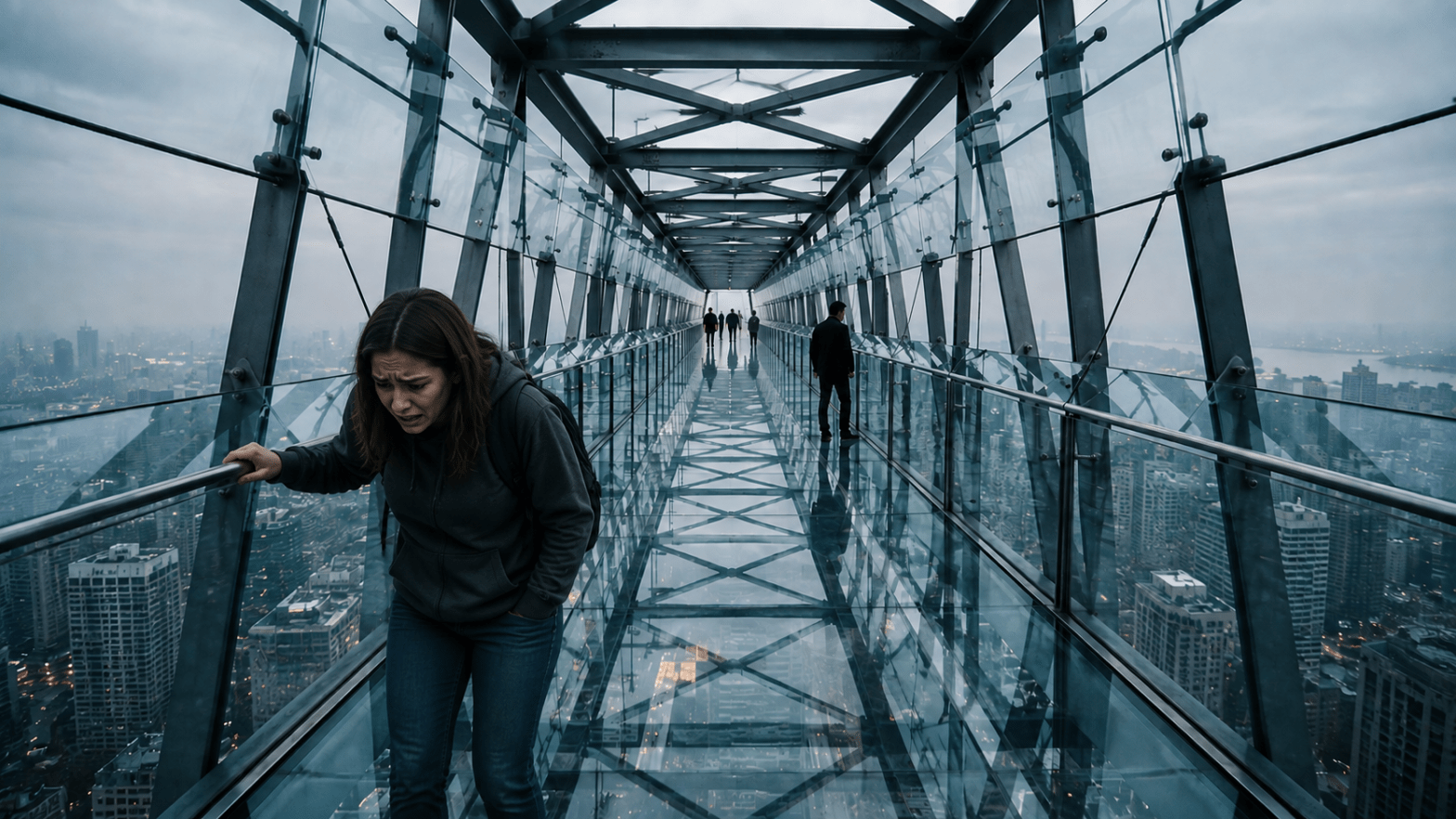
A glass bridge can be perfectly safe and still be difficult to cross.
The structure may have been engineered to withstand enormous loads, and the glass may have been carefully tested and securely supported. From an engineering perspective, there may be no reason to fear it. Yet for many people, standing on a transparent floor high above the ground produces an unmistakable feeling of danger. The bridge has not changed; what has changed is the way it is perceived.
That perception can influence behaviour. A person may hesitate before stepping forward, decide not to cross, or choose another route altogether. The example may seem extreme, but the same relationship between perception and behaviour operates in much more ordinary environments. A pavement can be technically accessible and yet feel unsafe. A park can be beautifully landscaped and still feel uninviting. A public square can be open and available but feel too exposed to enter. A building can comply with accessibility standards while remaining confusing, overwhelming or difficult to navigate.
The physical environment establishes what is possible, but perception influences what people actually choose to do. This distinction matters because architecture does not only shape the spaces available to us; it can also influence the boundaries of the world we feel able and willing to experience.
The environment we see is not necessarily the environment we experience
Architecture is often evaluated through characteristics that can be measured. We ask whether a pavement is wide enough, whether a gradient meets accessibility requirements, whether a crossing has been appropriately designed, whether there is sufficient seating, or whether a building complies with regulations. These questions are essential, particularly because objective barriers can prevent people from using environments in the first place. However, they do not tell us everything about how a place functions for the people who encounter it.
Two people can occupy exactly the same environment and experience very different levels of comfort, safety, stimulation or control. A busy city square may feel lively and engaging to one person, while the combination of noise, movement and unpredictability may be overwhelming to another. A forest path may feel peaceful and restorative to one visitor while producing a sense of vulnerability or unease in someone else. A large open-plan interior may be experienced as spacious and liberating by one person but exposed and uncomfortable by another.
The environment is the same. The experience is not.
This is one of the reasons neuroarchitecture needs to look beyond physical form and consider the relationship between environmental conditions, perception, cognition, emotion and behaviour. The question is not simply what a space contains, but how those characteristics are interpreted and what consequences that interpretation has for the person using it.
When perception changes where we walk
A study by Plaut, Shach-Pinsly, Schreuer and Kizony (2021), published in the Journal of Transport Geography, provides an interesting example of this relationship. The researchers examined the walking activity spaces of 271 adults aged 60 and over across three cities and analysed 483 walking routes. They compared spatial patterns among participants with different levels of fall risk and fear of falling.
The researchers found differences in the walking activity spaces of participants according to their levels of fall risk and fear of falling. Their findings suggest that fear of falling is not simply an internal experience that remains separate from everyday behaviour; it can be reflected in the geographical patterns of people’s walking activity.
This distinction is important. The city itself does not necessarily become physically smaller, but the part of the city that a person regularly uses can become smaller. A route may still exist, a park may remain nearby and a local shop may still be within a conventional walking distance. Yet if the journey is perceived as too risky, demanding or unpredictable, a person may choose not to make it.
This complicates our understanding of accessibility. A place can be physically accessible while remaining psychologically difficult to access.
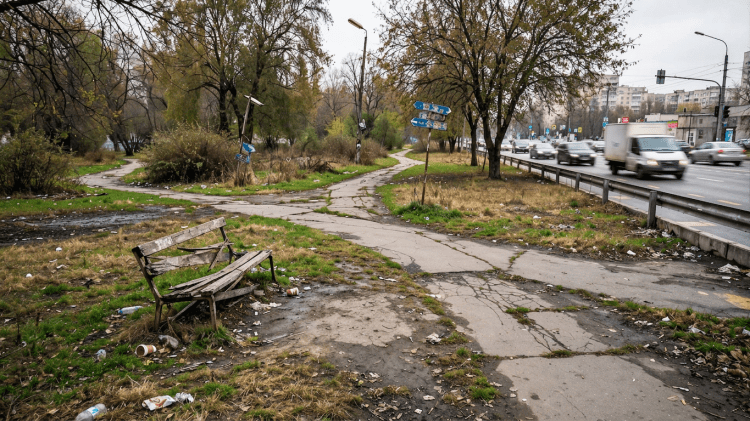
The park people do not feel able to use
A similar issue emerges when we consider urban green spaces. In my recent article, Not Every Green Space Is Restorative, I explored the assumption that introducing vegetation into an urban environment automatically creates a restorative setting. The presence of greenery is important, but it does not guarantee that people will experience a place as restorative or even choose to use it.
A park may contain trees, lawns and carefully selected planting and still fail to feel welcoming if people perceive it as unsafe or neglected. Beautiful views cannot compensate for poor maintenance, just as extensive lawns cannot replace comfortable places to sit or areas that provide a sense of refuge. Similarly, a green space exposed to persistent traffic noise may offer visual contact with nature while providing little opportunity for psychological restoration. A visually attractive layout can also become difficult to use if its paths are confusing or if people cannot easily understand where they are supposed to go.
The question therefore needs to move beyond whether a neighbourhood contains green space. We should also ask whether residents feel comfortable entering it, whether they can navigate it easily, whether it provides the conditions they need to remain there and whether they are likely to return.
The distinction is subtle but important: a resource that exists is not necessarily a resource that is experienced or used.
From walkability to experienced walkability
This connects directly with an earlier article, Neuroarchitecture: How Walkable Cities Fight Cognitive Decline, where I explored how walkable urban environments can support healthy ageing by encouraging physical activity, social interaction and everyday cognitive stimulation.
Walkability, however, is often treated as though it were primarily a measurable characteristic of the urban fabric. We calculate distances, assess connectivity, consider pavement conditions and evaluate access to services. These measures are valuable, but they do not necessarily tell us whether people experience a route as walkable.
Consider a short journey that technically meets accessibility requirements but involves uneven surfaces, heavy traffic, difficult crossings, little seating, poor lighting or a circulation pattern that is difficult to understand. The physical distance remains the same, but the perceived effort, uncertainty or risk associated with the journey may be enough to change behaviour.
This suggests that walkability is not simply a property of streets and pavements. It is also a relationship between a person and their environment.
A route can be objectively walkable while being subjectively difficult to use.
From physical accessibility to perceived accessibility
This raises a broader question about what we mean when we describe an environment as accessible.
Physical accessibility asks whether a person can physically enter and use a space. That is fundamental. But there is another layer: whether the environment feels sufficiently safe, understandable and manageable for the person to consider using it.
A ramp may provide physical access without creating a sense of confidence. A park may be within a five-minute walk but feel too unsafe to visit. A public building may provide step-free access but have such confusing circulation that a person avoids returning.
None of this means that perception is always accurate or that every feeling of discomfort can be resolved through design. People bring their own histories, expectations, physical abilities and previous experiences into every encounter with the built environment. What feels threatening to one person may feel completely ordinary to another.
But that does not make perception irrelevant to design.
If perception influences behaviour, then perception is part of the way an environment functions.
For neuroarchitecture, this is particularly important. The built environment is not experienced as a neutral collection of physical properties. It is continuously interpreted by the brain and body, and those interpretations can influence attention, emotion, movement, engagement and avoidance.
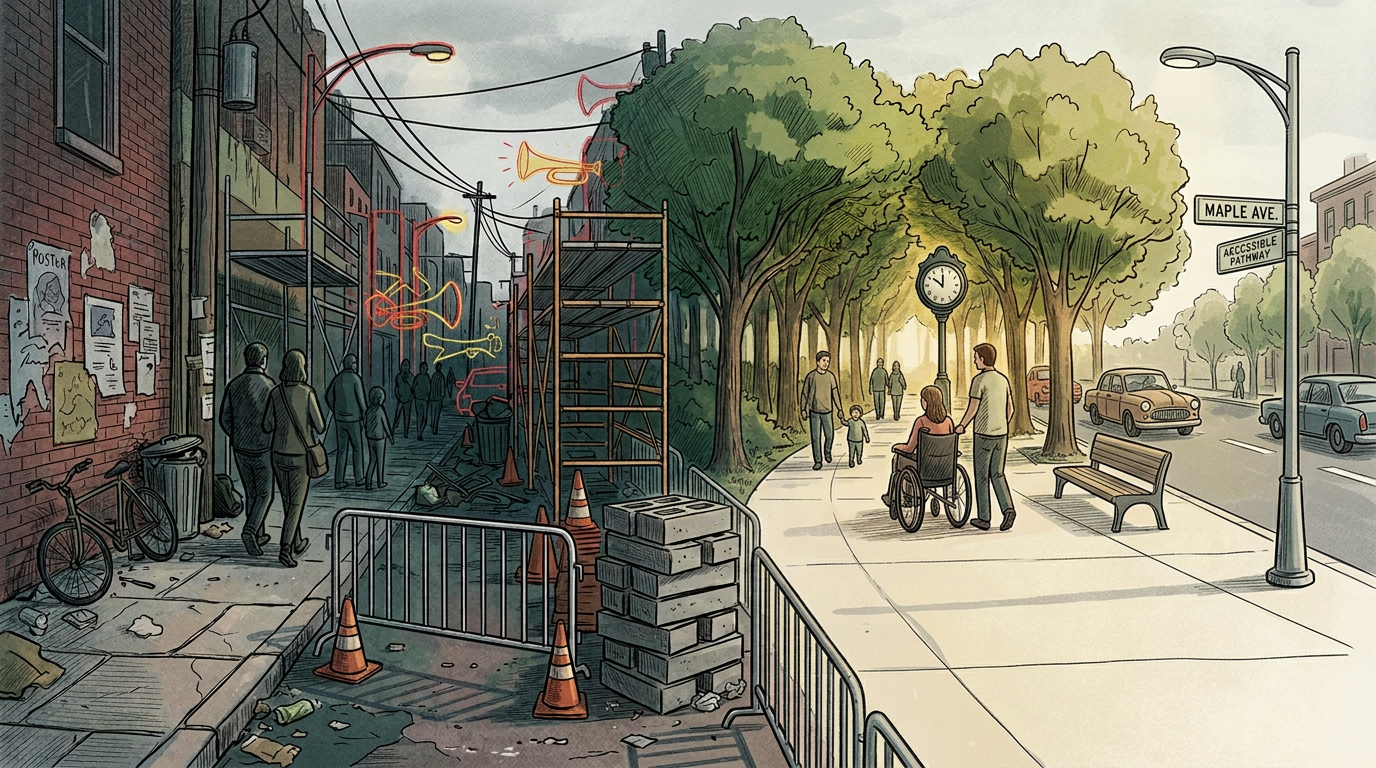
The glass bridge and the everyday city
The glass bridge makes this relationship unusually visible because the contrast between physical safety and perceived danger is so striking. The structure may be secure, but the person standing on it may experience a strong sense of vulnerability.
In everyday environments, the relationship is less obvious because perceptions of risk are shaped by many factors. Someone who has previously experienced a fall may interpret an uneven pavement differently from someone who has never fallen. Someone who has experienced harassment may perceive an isolated urban path differently from someone who feels comfortable walking there alone. Someone with sensory sensitivities may experience a crowded, brightly lit shopping street as overwhelming rather than stimulating.
The environment has not necessarily become objectively more dangerous for any of these people. Their relationship with the environment has changed because of their previous experiences, expectations, abilities or ways of processing sensory information.
This is where the concept of neurodiversity becomes particularly relevant. Human beings do not share a single sensory threshold, a single attentional profile or a single way of interpreting environmental information. Designing for human experience therefore requires us to recognise variability rather than assuming that one environment will produce one predictable response.
Same space, different worlds
This is also the principle explored in my article The Same Classroom, Different Outcomes. The same physical classroom can support one student’s attention while making it considerably more difficult for another student’s brain to regulate attention, process sensory information or remain engaged.
The same principle extends beyond education.
A classroom is not simply a collection of desks and walls. A park is not simply an area of grass and planting. A pavement is not simply a walking surface. A city is not simply an aggregation of streets, buildings and infrastructure.
These environments are encountered by bodies and brains with different sensory thresholds, memories, expectations, physical capacities and needs. The qualities of a place, therefore, cannot be understood independently from the people experiencing them.
A quiet corner can provide refuge for one person and feel isolating to another. An open space can provide freedom for one person and exposure for another. Visual complexity can create interest for one person while making information harder to process for another.
This does not mean that architecture can or should be designed to eliminate difference. Rather, it suggests that good design should provide enough choice, clarity and flexibility to accommodate a reasonable range of human experiences.
The invisible shrinking of our environments
One of the most difficult consequences of this relationship is that exclusion does not always announce itself.
People do not necessarily complain when an environment does not work for them. They may simply adapt their behaviour. They take a longer route, stop visiting a particular park, avoid unfamiliar parts of the city, remain indoors more often or choose the familiar option instead of exploring somewhere new.
Each decision can appear insignificant. Over time, however, these decisions can accumulate.
The physical boundaries of the city remain unchanged, while the boundaries of a person’s experienced environment gradually contract.
For an older adult who avoids certain routes because of fear of falling, this may mean fewer opportunities for physical activity and social interaction. For someone who avoids a park because it feels unsafe or unwelcoming, it may mean losing access to a potentially restorative environment. For someone who avoids a public building because its layout is confusing or overwhelming, it may mean reduced participation in services, cultural activities or community life.
The consequence is therefore not simply that a particular place is unpleasant.
It is that the range of places a person feels able to use can become smaller.
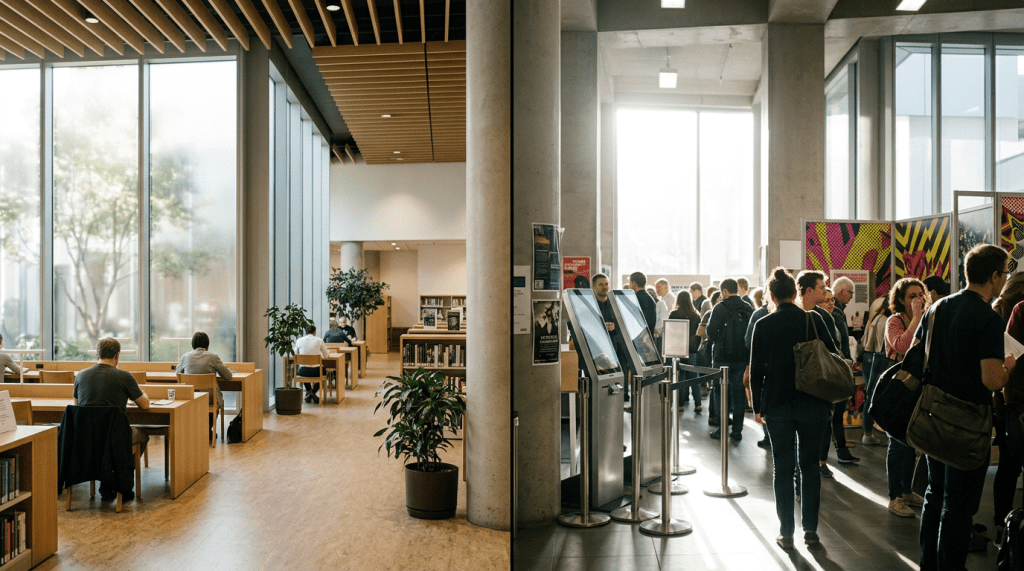
Designing for a larger lived world
This does not mean that architecture can eliminate fear, anxiety or individual differences. Nor should every environment be made identical, completely predictable or universally comfortable. Diversity of experience is part of what makes places meaningful.
The challenge is to reduce unnecessary barriers and provide environments that support a wider range of people.
A well-designed walking route can provide clear paths, appropriate crossings, places to rest and a sense of continuity. A park can offer different levels of activity, visibility, refuge and social interaction. A public building can provide legible circulation, predictable transitions and opportunities to pause.
These qualities do more than improve the physical environment. They can increase the likelihood that people will feel able to use the possibilities that the environment provides.
This is perhaps another way of understanding inclusive design. It is not only about whether a person can physically enter a space. It is also about whether the environment gives them a reasonable opportunity to understand it, navigate it, feel comfortable within it and choose to remain there.
What should we really measure?
This brings us back to the question at the heart of the article.
If a space meets technical accessibility requirements but people avoid using it, has the design fully succeeded?
If a park is within a five-minute walk but residents do not feel comfortable entering it, how accessible is that park in everyday life?
If a pedestrian route is physically possible but perceived as too risky to use, can we genuinely describe the neighbourhood as walkable?
These are not arguments against standards, regulations or objective measurements. Those remain essential. They are an argument for adding another layer of evaluation.
We need to consider the difference between what the environment allows, what people perceive and what people actually do.
These three dimensions are closely related, but they are not identical.
For architects and urban designers, this means that the success of a space cannot always be understood by looking at the physical environment alone. We also need to pay attention to the behaviours, experiences and choices that emerge from the relationship between people and place.
Architecture can make our world smaller — or larger
The glass bridge reminds us that physical safety and perceived safety are not always the same. The study of older adults suggests that fear of falling can be reflected in the spatial extent of everyday walking. Urban parks remind us that the presence of greenery does not automatically make a place restorative. And neurodiversity reminds us that the same physical environment can place very different demands on different people.
Together, these examples point towards a broader principle: the world available to us is shaped not only by the physical spaces around us but also by how those spaces are perceived and experienced.
Architecture therefore has the potential to do more than provide physical access. It can help people feel able to move, explore, participate, pause, connect and remain in a place. Equally, when environments create unnecessary uncertainty, discomfort or perceived risk, they can quietly encourage people to stay away.
Perhaps the true measure of inclusive design is therefore not simply whether a person can use a space, but whether the environment gives them a reasonable opportunity to feel able and willing to use it.
Because ultimately, the size of our lived world is not measured only in metres or square kilometres. It is measured in the places we feel able to enter, explore and inhabit.
Architecture can influence how large that world becomes.
References
Plaut, P., Shach-Pinsly, D., Schreuer, N., & Kizony, R. (2021). The reflection of the fear of falls and risk of falling in walking activity spaces of older adults in various urban environments. Journal of Transport Geography, 95, 103152. https://doi.org/10.1016/j.jtrangeo.2021.103152
Fierro-Newton, P. (2026, June 20). Neuroarchitecture: How walkable cities fight cognitive decline. Neurotectura.
Fierro-Newton, P. (2026, August 15). Not every green space is restorative. Neurotectura.
Fierro-Newton, P. (2026, August 2). The same classroom, different outcomes. Neurotectura.

