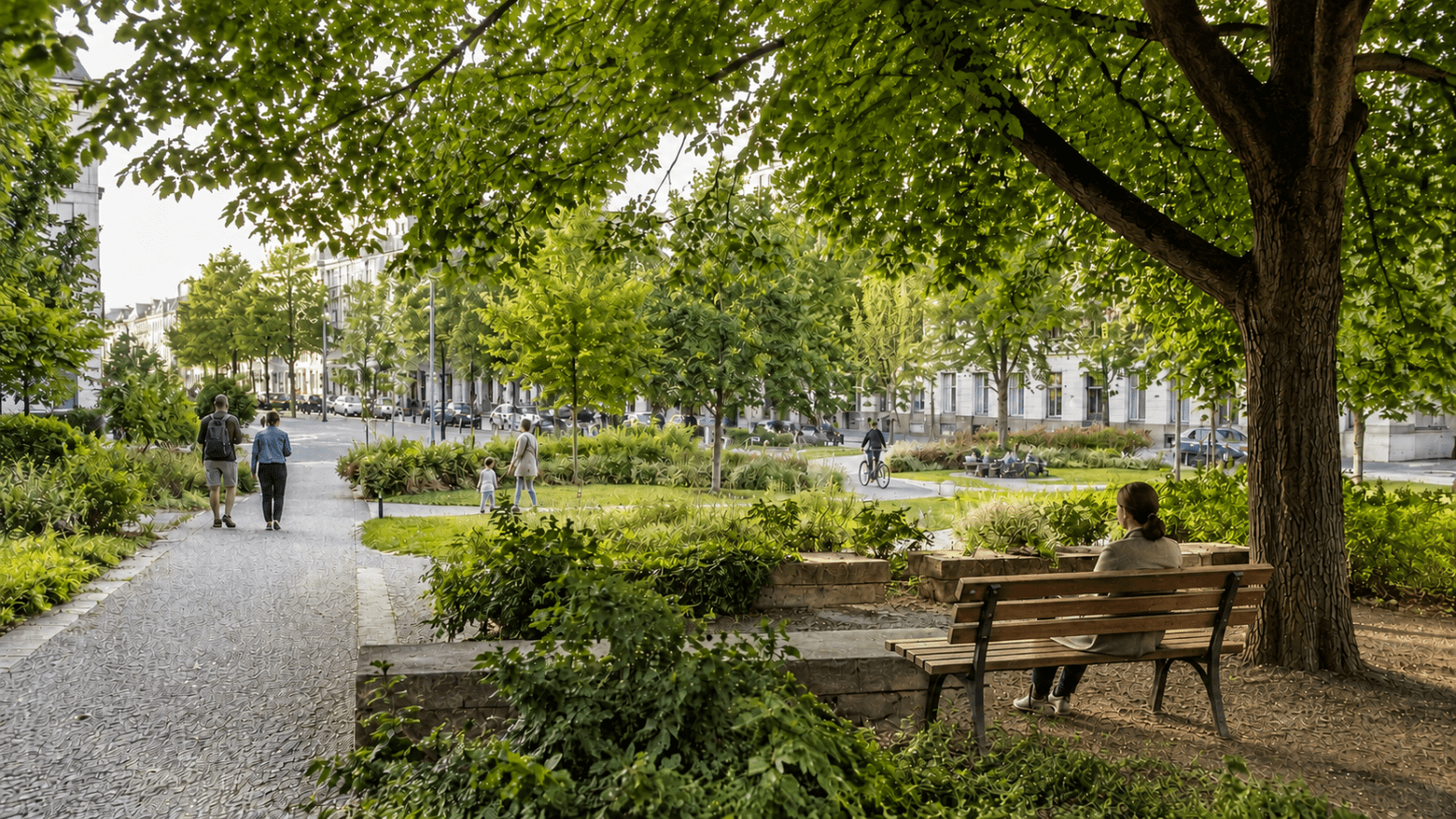
Urban parks are frequently presented as a straightforward remedy for the pressures of city life. Add trees, create a lawn, provide a path, and people will supposedly feel calmer, think more clearly, and enjoy better health.
But the presence of vegetation does not automatically make a place restorative.
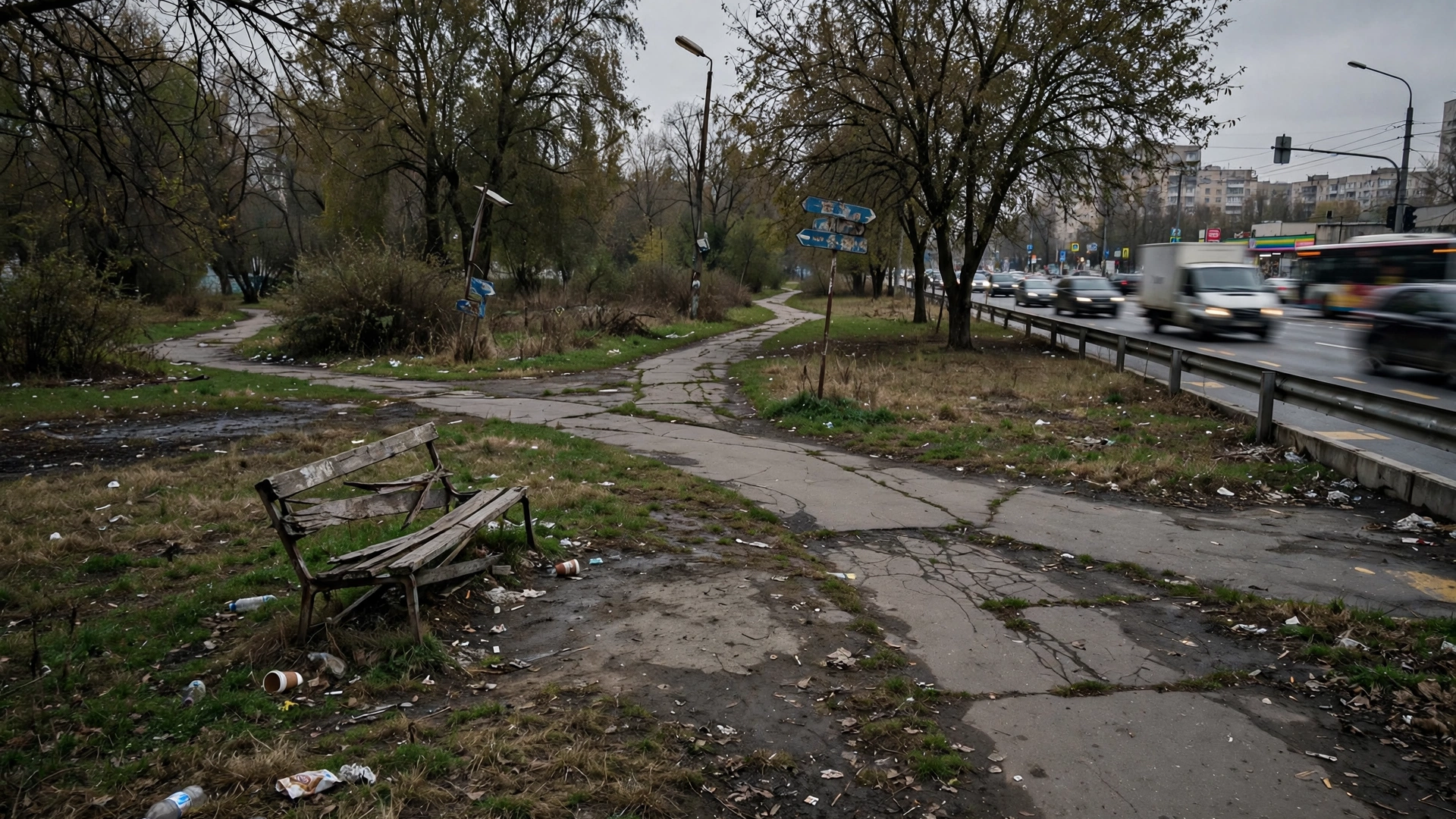
A park may contain trees and still feel unsafe. It may offer open space but expose visitors to traffic noise, poor maintenance or confusing circulation. It may be visually attractive yet provide nowhere comfortable to sit, play, exercise, meet others or withdraw from activity.
A recent study published in the Journal of Environmental Psychology challenges the assumption that visiting a park is necessarily equivalent to having a restorative experience in nature. Instead, it suggests that the psychological benefits of urban parks emerge through a more complex interaction between environmental qualities, available amenities, desired activities and the visitor’s familiarity with the place.
The question, therefore, is not simply whether a city provides green space. It is whether that space enables people to feel safe, comfortable and able to do what they came there to do.
What Makes an Environment Restorative?
Everyday life requires us to direct our attention continuously. We concentrate on work, follow conversations, navigate traffic, ignore distractions and monitor what is happening around us. This effort is not unlimited. After prolonged use, our ability to focus may become fatigued.
Attention Restoration Theory, developed principally by Rachel and Stephen Kaplan, proposes that certain environments can help replenish this capacity. Natural settings are thought to be particularly supportive because they can hold our attention without demanding the same sustained mental effort required by many everyday tasks.
The theory identifies four qualities commonly associated with restorative experiences:
Being away: A sense of psychological or physical distance from routine demands.
Fascination: Stimuli that attract attention relatively effortlessly, such as moving water, foliage, clouds or changing patterns of light.
Extent: The feeling that an environment is coherent and sufficiently rich to invite exploration.
Compatibility: A good fit between what a person wants or needs to do and what the environment allows them to do.
These qualities help explain why a walk in a woodland, time beside water or even a view of trees may feel mentally refreshing. However, urban parks are not interchangeable with untouched natural landscapes. They are designed public environments containing paths, benches, playgrounds, sports facilities, lighting, buildings and social activity. Their restorative potential therefore depends on much more than the quantity of vegetation they contain.
Studying People in Real Urban Parks
In this preregistered, cross-sectional field study, Kathryn Schertz and colleagues investigated how different qualities of urban parks were associated with visitors’ emotions, perceived cognitive restoration and preference for the place.
Rather than asking participants to evaluate photographs from a laboratory, the researchers studied their experiences while they were physically present in parks across Chicago.
The study included 303 Chicago residents, who completed a total of 1,234 park visits over two weeks. During each visit, participants used their phones to evaluate the park and report how they felt at that moment.
They rated environmental qualities, including naturalness, safety, maintenance and noise. They also completed measures related to perceived restorativeness, emotional state, subjective cognitive restoration and their overall preference for the park.
This real-world approach is important. A photograph can show trees, water or an attractive path, but it cannot fully reproduce the sound of traffic, the condition of the seating, the presence of other people, the feeling of safety or the activities taking place nearby. By collecting responses within the parks themselves, the researchers captured some of the complexity of experiencing urban green space in everyday life.
Nature Was Important—but It Was Not the Whole Story
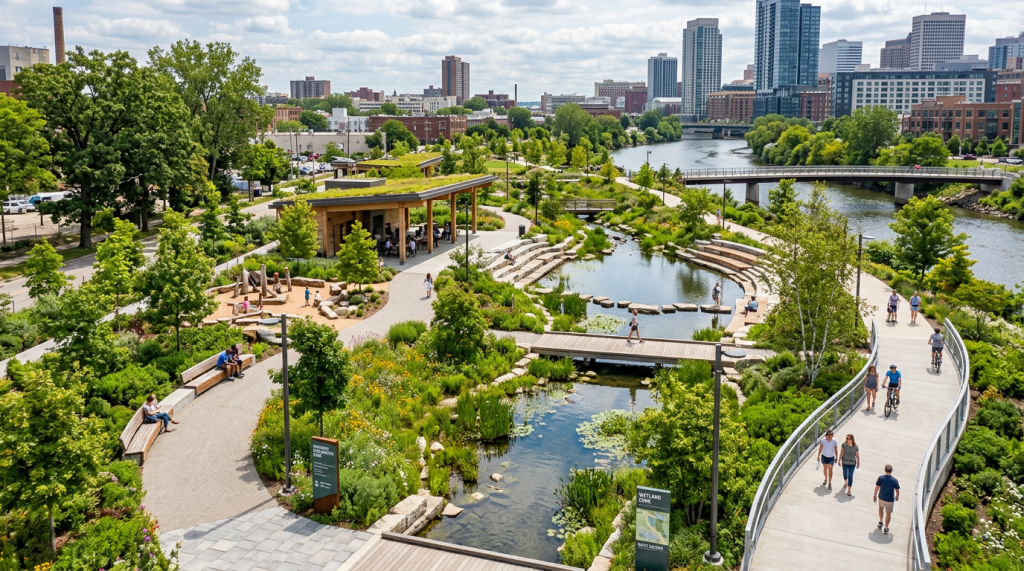
The findings showed that perceived naturalness was associated with more positive emotional states and greater subjective cognitive restoration.
Safety, maintenance, noise and other perceived environmental qualities were also related to how restorative participants found the park and how they felt while visiting it.
This distinction matters. Urban greening policies often focus on measurable quantities: the number of trees planted, the percentage of green coverage or the distance between homes and the nearest park. These indicators are valuable, but they do not necessarily tell us how a place is experienced.
Two parks can contain similar amounts of vegetation but place very different demands on their visitors. One may feel calm, cared for and easy to understand. The other may be noisy, neglected, difficult to navigate or perceived as unsafe.
A tree canopy may offer shade and visual fascination, but its psychological benefits may be weakened if a visitor must remain alert to fast-moving bicycles, poorly defined paths or threatening social conditions. An environment cannot easily support restoration when it simultaneously requires continuous vigilance.
Maintenance is especially significant in this context. It is sometimes treated as a practical concern that comes after design, rather than as part of the experience of the place. Yet broken furniture, accumulated rubbish, damaged paths and neglected vegetation may signal that a space is not cared for. These conditions can affect perceptions of safety, belonging and whether a visitor feels welcome.
Restoration is therefore not produced by nature alone. It depends on the complete environment through which nature is encountered.
A Park Must Support What People Want to Do
One of the study’s most interesting findings concerned compatibility.
Participants reported the activities they wanted to undertake and considered whether the park provided the amenities necessary to support them. These might include walking paths, seating, playgrounds, sports facilities or areas for socialising.
When participants visited parks they already knew, the compatibility between their desired activities and the available amenities helped predict how much they preferred the park. In other words, familiarity allowed people to evaluate the place partly through what it enabled them to do.
A person seeking quiet contemplation may value a secluded bench. Someone accompanying children may need a playground, nearby seating and clear visibility. Another visitor may look for an uninterrupted walking route, a sports court, an open lawn or a place to meet friends.
None of these needs can be reduced to the presence or absence of trees.
This finding reinforces an important principle of environmental design: people do not experience places only as visual compositions. They experience them through intentions, actions and bodily possibilities.
A beautiful park that does not support the visitor’s purpose may be less satisfying than a more modest space that allows the desired activity to happen comfortably. Design quality is not only about what a place looks like but also about what it makes possible.
First Impressions and the Decision to Return
The relationship changed when people encountered a park they had not visited before.
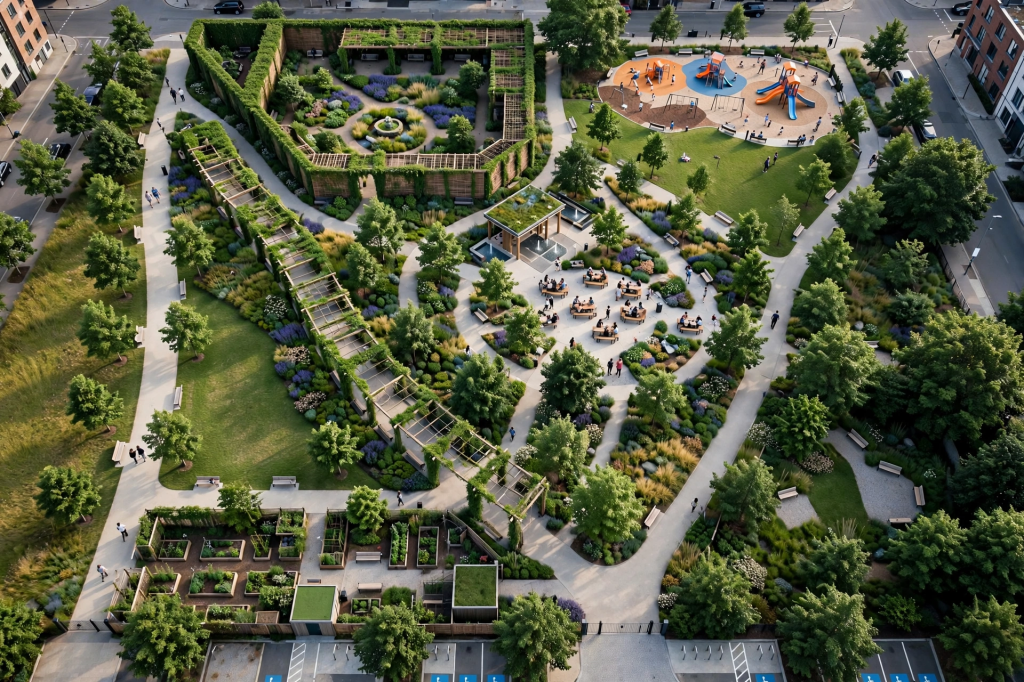
In unfamiliar parks, compatibility between desired activities and amenities did not predict preference in the same way. Instead, broader impressions such as naturalness, safety and maintenance were particularly relevant to participants’ interest in returning.
This suggests that visitors may evaluate unfamiliar environments in stages.
Before discovering everything a park offers, they must first decide whether it appears welcoming enough to explore. Is the entrance visible? Do the paths seem understandable? Does the place feel cared for? Can the visitor anticipate what lies ahead? Does the social environment feel comfortable?
Only after becoming familiar with the park may its detailed compatibility with personal routines and preferred activities become more important.
This has practical implications for design. A park may contain excellent facilities that remain unused if its entrance feels unwelcoming, its layout is difficult to interpret or visitors do not initially feel safe enough to explore it.
Legibility, maintenance and perceived safety are not secondary aesthetic details. They may determine whether people ever discover the park’s other qualities.
Restorative for Whom?
Although this study advances our understanding of urban parks, it also raises a question that deserves greater attention:
Who is able to experience a particular environment as restorative?
People do not arrive in parks with identical sensory thresholds, physical abilities, cultural expectations or emotional associations. The same setting may calm one visitor while placing significant demands on another.
For an autistic person, a park that appears calm and restorative to others may present significant sensory and cognitive demands. Barking or unpredictable dogs, children shouting, maintenance machinery, crowded paths and abrupt transitions between quiet and highly active areas may make it difficult to relax or feel in control of the experience.
Someone with ADHD may benefit from movement and environmental stimulation while also needing protection from competing distractions. A person with mobility difficulties may be unable to reach the most attractive or secluded part of the park. Someone living with anxiety or trauma may respond strongly to restricted visibility, isolated routes or the absence of clear exits.
These possibilities were not directly tested in the Chicago study. We should therefore not present its findings as evidence about neurodivergent or disabled visitors. Nevertheless, the study’s emphasis on compatibility provides a useful foundation for more inclusive thinking.
Compatibility is not simply a relationship between an activity and an amenity. It is also a relationship between the environmental demands of a place and the perceptual, cognitive and physical needs of the person using it.
A genuinely inclusive park might therefore provide different sensory and social conditions within the same landscape:
- active areas and quieter areas;
- exposed routes and more sheltered alternatives;
- opportunities for social interaction and places to withdraw;
- seating with different levels of enclosure and visibility;
- clear paths and recognisable landmarks;
- accessible routes that do not separate disabled visitors from the central experience;
- sufficient distance between incompatible activities;
- advance information about facilities, entrances and sensory conditions.
The objective is not to create a universally calm environment. Some people seek movement, play, social energy and stimulation. Others seek solitude, predictability and relief from sensory demands. Inclusive design provides meaningful choices between these experiences.
Access Is Not the Same as Benefit
These findings also invite us to reconsider how equality is assessed in urban green-space provision.
A neighbourhood may technically have access to a park, but that does not mean residents receive its potential benefits. If the park is unsafe, poorly maintained, excessively noisy or unsuitable for locally valued activities, geographical proximity alone tells us very little about its restorative value.
This is particularly important in disadvantaged communities, where the provision of new green infrastructure can attract more political attention than the continuing care of existing spaces. Planting trees or creating a new park can be photographed, counted and announced. Long-term maintenance, community participation and adaptation to changing needs are less visible—but may be equally important.
Environmental justice must therefore consider quality as well as quantity. It should ask not only who lives near green space but also:
Who feels welcome there?
Who can reach and navigate it?
Whose activities does it support?
Who feels safe enough to remain?
Who has access to quieter, better-maintained and more restorative environments?
Without these questions, green-space provision risks becoming a numerical achievement rather than a meaningful improvement in everyday life.
What the Study Cannot Tell Us
The study offers valuable real-world evidence, but its limitations are important.
It was cross-sectional, meaning that it identified relationships between participants’ perceptions and reported outcomes but cannot establish that particular park qualities directly caused improvements in cognition or emotion.
The cognitive restoration measure was also subjective. Participants reported whether they felt mentally restored; the researchers did not demonstrate improvement through objective tests of attention, memory or executive function during each park visit.
Perceptions of safety, naturalness, maintenance and noise are meaningful because they shape experience, but they are not equivalent to independently measured environmental conditions. Personal history, familiarity, mood, identity and expectations may all influence how someone evaluates the same setting.
The study was conducted with residents of one American city, and its findings should not automatically be generalised to other cultural, climatic or urban contexts. Chicago’s parks, patterns of use and social conditions are not identical to those of London, Bogotá or other cities.
These limitations do not invalidate the findings. They clarify what the research can responsibly support: certain perceived qualities of urban parks were associated with better reported emotional and cognitive experiences. Further research is needed to establish causal relationships and understand how these experiences vary across populations and places.
Designing the Conditions for Restoration
The study by Schertz and colleagues moves the conversation beyond the simplistic idea that nature automatically produces wellbeing.
Urban parks are simultaneously natural, designed, social and functional environments. Their restorative value emerges from the interaction between vegetation, sensory conditions, maintenance, safety, amenities, activities and the individual visitor.
This does not mean that every park must provide everything for everyone. It means that designers and decision-makers should stop treating “green space” as a complete description of environmental quality.
A restorative park is not created simply by inserting nature into the city. It must allow people to lower their vigilance, orient themselves, find an appropriate level of stimulation and engage in activities that matter to them.
The more useful question is therefore not:
Does this neighbourhood have a park?
It is:
Under what conditions, for which people and for which activities can this park become restorative?
The distinction may appear subtle, but it changes the purpose of design. It shifts attention from providing green space as an object to creating an environment capable of supporting real human needs.
References
Kaplan, S. (1995). The restorative benefits of nature: Toward an integrative framework. Journal of Environmental Psychology, 15(3), 169–182. https://doi.org/10.1016/0272-4944(95)90001-2
Schertz, K. E., Meidenbauer, K. L., Freeman, T. R., Santiago, I. M., Janey, E. A., Gehrke, K., Samtani, A. L., Stier, A. J., & Berman, M. G. (2025). Identifying qualities and amenities associated with subjective cognitive restoration and improved affect in urban parks. Journal of Environmental Psychology, 104, 102624. https://doi.org/10.1016/j.jenvp.2025.102624
Smiley, K. T., Sharma, T., Steinberg, A., Hodges-Copple, S., Jacobson, E., & Matveeva, L. (2016). More inclusive parks planning: Park quality and preferences for park access and amenities. Environmental Justice, 9(1), 1–7. https://doi.org/10.1089/env.2015.0030


One thought on “Not Every Green Space Is Restorative”