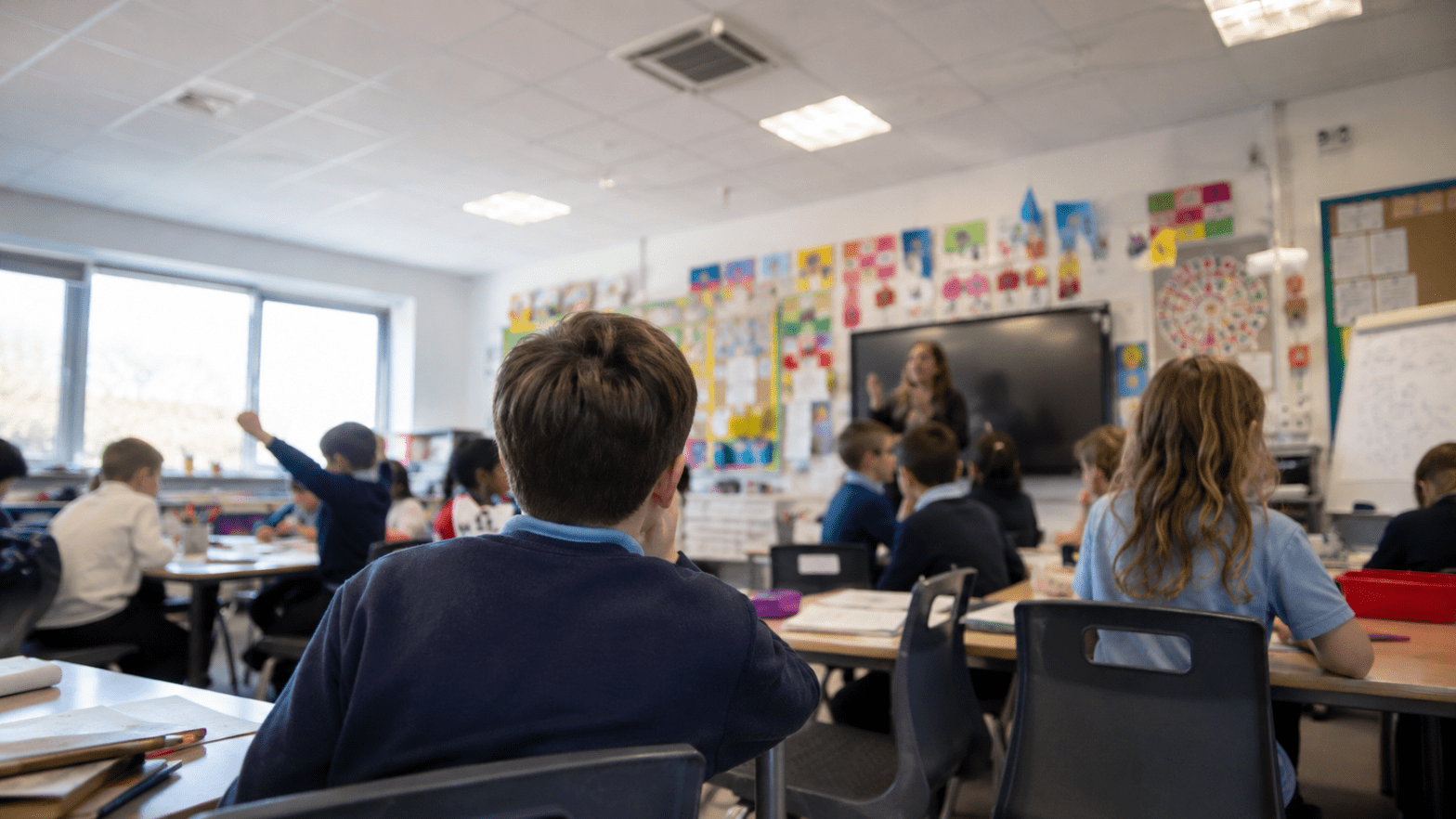
A student looks away while the teacher is speaking. Another repeatedly taps a pencil, rocks in their chair or asks to leave the room. A third completes very little work despite appearing to understand the subject.
These behaviours may be interpreted as inattentiveness, lack of motivation or unwillingness to participate. Yet the difficulty may not lie entirely within the student. It may arise from the amount of sensory and attentional effort required simply to remain in the classroom.
Before a student can concentrate on a lesson, they must distinguish the teacher’s voice from surrounding conversations, ignore movement elsewhere in the room, adjust to lighting and glare, tolerate physical proximity and decide which visual information deserves their attention. Most classrooms require the brain to process—or suppress—multiple streams of information simultaneously.
For some learners, particularly autistic students, this filtering process may demand substantial cognitive effort. If the environment continually competes with the lesson, how many resources remain available for learning?

The hidden work of paying attention
In a 2021 integrative review, researchers Courtney Mallory and Brandon Keehn examined how sensory processing and attentional differences associated with autism may affect students in academic environments.
The authors begin with an apparently ordinary classroom scene: a teacher presenting information while papers shuffle, air moves through a ventilation system and elaborate displays cover the walls. Students are expected to attend to the lesson while filtering out these competing sensations.
Attention, however, is not simply a matter of looking at the teacher or remaining seated. It involves selecting relevant information from numerous internal and external sources. It also requires the brain to disengage from one stimulus, shift towards another and inhibit information that is not relevant to the task.
Mallory and Keehn describe research indicating that autistic people may experience differences across several attentional processes. These can include difficulties disengaging and shifting attention, regulating alertness and filtering irrelevant visual or auditory information.
This does not necessarily indicate a general lack of attention. The review notes that autistic participants can demonstrate sustained attention comparable to that of non-autistic peers, even while experiencing difficulties with other attentional processes. An autistic student may concentrate intensely in some circumstances while finding it difficult to redirect that attention when the activity changes. They may also process information that other students barely notice.
What appears to be distraction may therefore reflect a different distribution of attention—not its absence.
Sensory processing is not the same for everyone
Sensory processing involves detecting, registering and interpreting information received through the senses. The paper draws on Dunn’s model, which considers both a person’s sensory threshold and how they respond to sensory experiences.
Some students notice sensory input very quickly and may become overwhelmed by sounds, light, touch or movement that others can tolerate. Others require stronger input before registering what is happening around them. A student may actively seek movement or tactile stimulation, while another may avoid situations involving unpredictable sensations.
These patterns are not mutually exclusive or necessarily consistent across every sense. The same learner may be particularly sensitive to certain forms of input while seeking or requiring more input through another sensory modality.
This variability matters because there is no single sensory environment that will work equally well for every autistic student—or, indeed, for every student.
A classroom that is calming for one child could leave another insufficiently alert. Bright lighting may help some learners remain alert while causing glare or discomfort for others. Absolute uniformity cannot respond to this diversity.

When noise consumes the resources needed for learning
Among the different sensory conditions considered in the review, auditory input emerges as a particularly important issue.
Classroom learning depends heavily on speech. To understand the teacher, students must separate the teacher’s voice from conversations, scraping chairs, footsteps, ventilation systems, sounds from corridors and activity outside the building.
When the difference between the target voice and background noise is insufficient, listening requires greater effort. Cognitive resources must be devoted to identifying and interpreting speech—resources that might otherwise support comprehension, memory and participation.
Background speech can be especially disruptive because it contains meaningful information. Unlike a continuous mechanical sound, another conversation can involuntarily attract attention and compete with the teacher’s words.
Mallory and Keehn report evidence that autistic students may experience particular difficulty processing speech in noisy environments and filtering irrelevant auditory information. The review also discusses studies associating higher classroom noise levels with greater stress and more frequent repetitive behaviours.
This invites an important change in interpretation. Repetitive movement, withdrawal or apparent disengagement in a noisy classroom should not automatically be regarded as misbehaviour. It may reflect sensory stress or an attempt to regulate, preserve attention or regain a sense of control.
From a design perspective, acoustics are therefore not merely a matter of comfort. They can influence whether spoken educational information is genuinely accessible.
The visually busy classroom
Classrooms are often decorated with posters, artwork, alphabets, numbers, timetables, motivational messages and displays of students’ work. These elements may create identity, communicate information and celebrate achievement. More decoration, however, does not automatically produce a better learning environment.
The review discusses research associating heavily decorated classrooms with greater off-task behaviour and smaller learning gains, particularly among younger children. Studies reviewed by the authors also suggest that high levels of background visual information may be especially distracting for autistic students.
This does not mean classroom walls should be empty. Mallory and Keehn note that limited and relevant visual information may be helpful. The implication is that displays should be purposeful, organised and responsive to the activities taking place. Information that supports the current lesson may be valuable; material that is no longer relevant may become persistent visual competition.
Lighting introduces another layer of complexity. Daylight may support learning and alertness, but uncontrolled direct sunlight can create glare. The review also reports sensitivity to lighting among many autistic people and discusses small studies in which less intense or modified lighting was associated with improved attention, engagement or participation.
These findings should be interpreted cautiously. They do not establish one ideal form of lighting for every learner. They do, however, support giving greater consideration to intensity, glare, artificial light sources and individual responses.
The relevant question is not simply whether a classroom has sufficient light or attractive displays. It is how those conditions are experienced by different learners during particular tasks.
From correction to accommodation
Educational responses often focus on changing the student: encouraging longer periods of sitting, reducing repetitive behaviour or teaching the child to ignore distractions. Some individual support may be valuable, but it should not prevent us from addressing unnecessary environmental demands.
Mallory and Keehn discuss several possible accommodations, including reducing auditory and visual distractions, improving the signal-to-noise ratio, creating quieter work areas, allowing sensory breaks and considering where a student is seated.
Translated into spatial design, these principles could include:
- acoustic treatment that reduces reverberation and background noise;
- quieter areas that remain connected to, rather than isolated from, the classroom;
- clearly organised and selectively displayed visual information;
- adjustable lighting and effective control of glare;
- seating choices that offer different degrees of enclosure and social proximity;
- predictable spatial organisation and legible transitions;
- places where students can move or regulate without being treated as disruptive;
- flexibility to change environmental conditions according to the learner and activity.
These are not features exclusively for autistic students. Improved acoustics, clearer organisation and greater environmental choice may benefit teachers and many other learners, including students with ADHD, sensory sensitivities, hearing difficulties, anxiety or language-processing differences.
Inclusive design does not require every person to use a space in the same way. It requires the space to provide more than one viable way to participate.

What the research cannot yet tell us
The Mallory and Keehn paper is an integrative review that brings together findings from different areas of research. The authors explicitly describe their approach as non-systematic. It should therefore not be interpreted as proving that a specific classroom design will produce a particular academic outcome.
Much of the literature also examines isolated variables or relies on behavioural reports and controlled tasks. Real classrooms are more complex. Noise interacts with lighting, social density, temperature, teaching style, task difficulty, familiarity and the student’s physical and emotional state.
The review also demonstrates why universal prescriptions would be inappropriate. Autistic people are not a homogeneous group, and their sensory profiles cannot be inferred reliably from a diagnostic label alone.
The evidence supports a direction rather than a formula: reduce unnecessary sensory competition, provide meaningful choice and evaluate environments with the people who actually use them.
Future research should investigate these relationships in real learning environments and include autistic students as participants in defining problems, evaluating spaces and developing solutions.
Designing for access to learning
A classroom is not a neutral container in which education happens. It continually directs attention, amplifies or suppresses sound, exposes students to movement and light, determines proximity and influences whether retreat or regulation is possible.
When these demands align with a learner’s needs, the environment may support participation almost invisibly. When they do not, the student may have to devote substantial energy to managing the room before engaging with the lesson.
The central question is therefore not whether a student can tolerate the classroom as it currently exists. It is whether the classroom gives that student a fair opportunity to attend, understand and learn.
Sometimes what looks like a failure to pay attention is evidence that the environment is demanding too much attention of its own.
Reference
Mallory, C., & Keehn, B. (2021). Implications of sensory processing and attentional differences associated with autism in academic settings: An integrative review. Frontiers in Psychiatry, 12, Article 695825. https://doi.org/10.3389/fpsyt.2021.695825

